
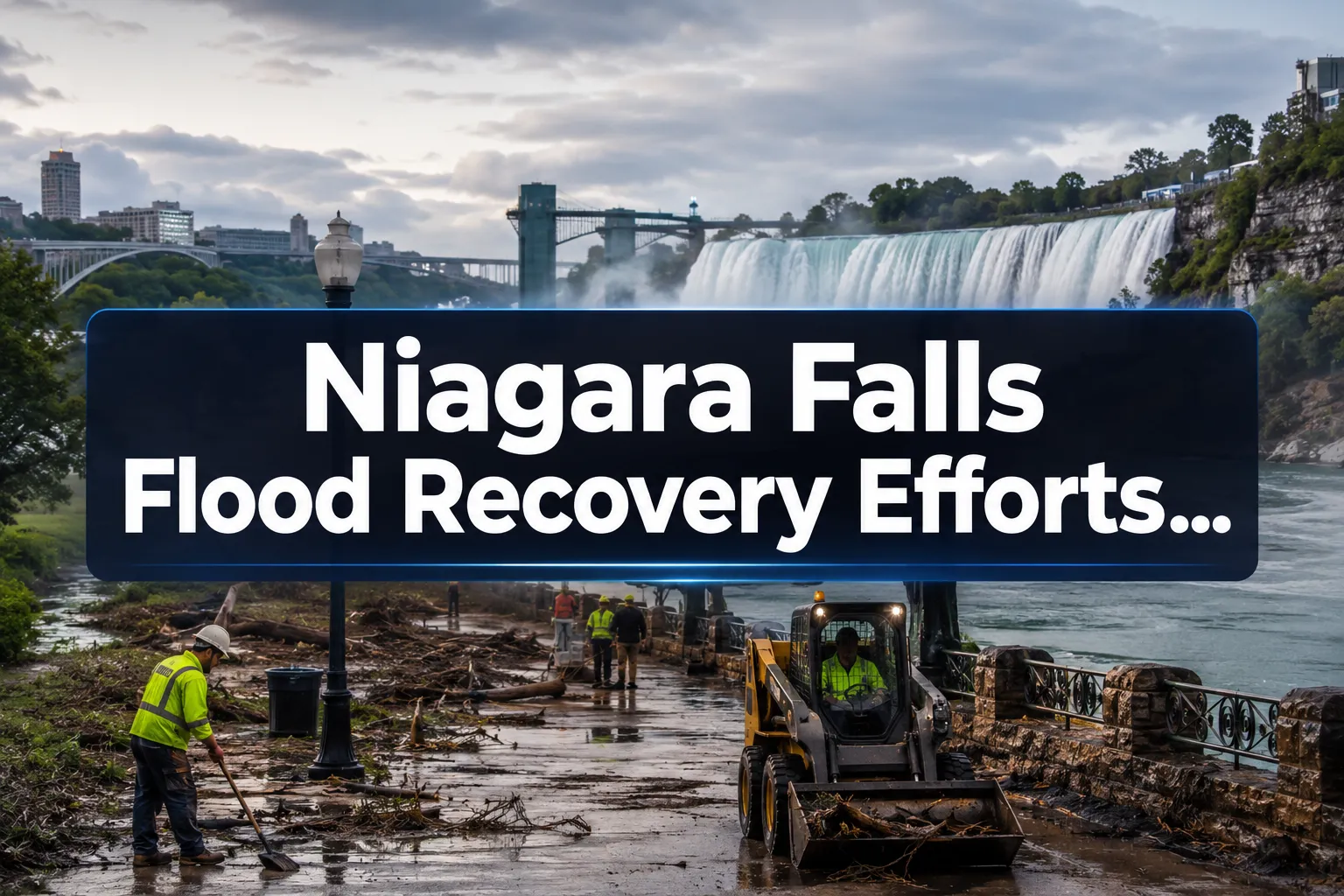
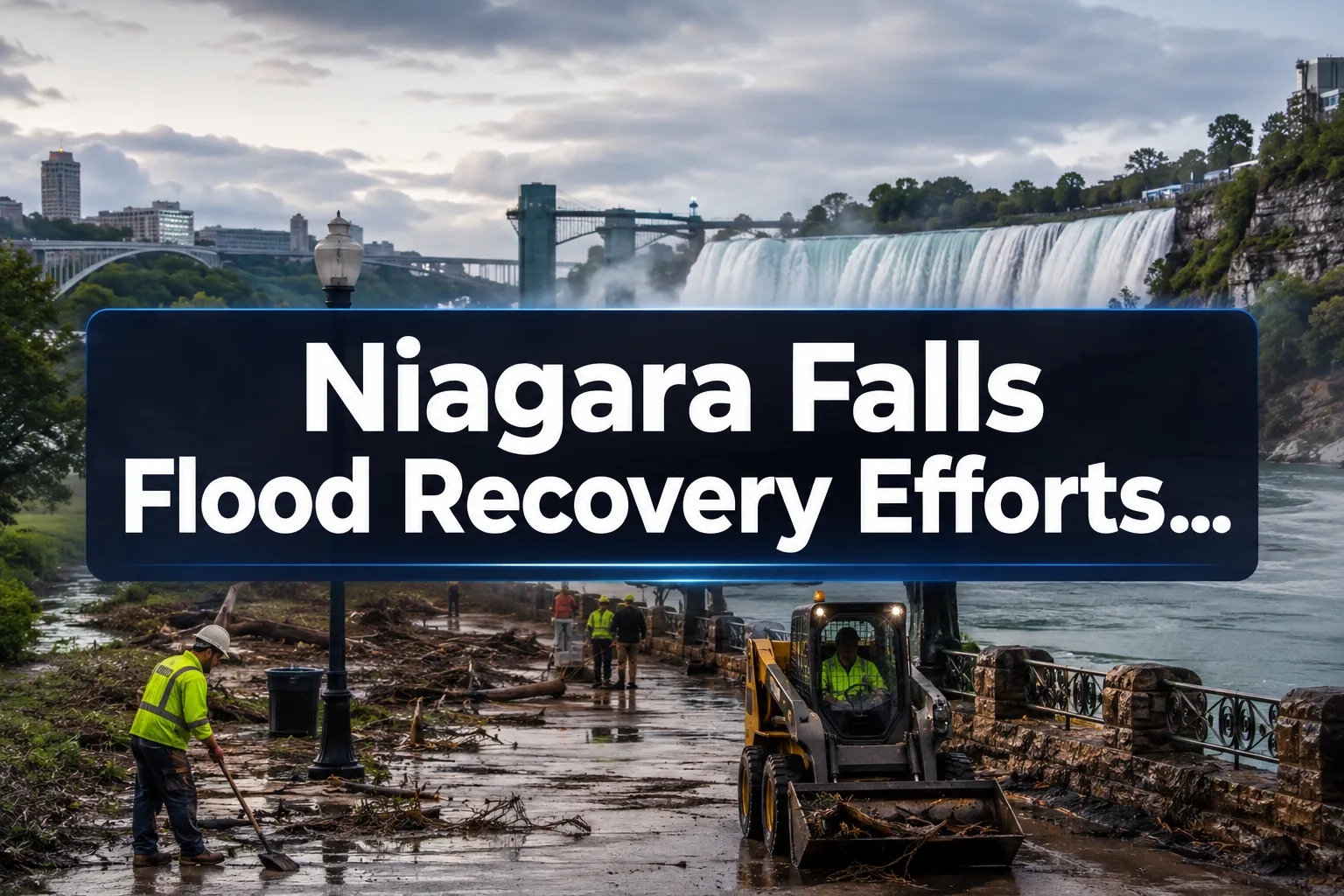
{“cover”:”Professional landscape format (1536×1024) hero image with bold text overlay (≤42 chars): ‘Niagara Falls Flood Recovery’ in crisp white bold sans-serif on a deep navy semi-transparent overlay panel, centered upper-third, 8% safe margins from every edge. Background: dramatic editorial aerial photograph of Niagara Falls city streets with standing floodwater reflecting overcast sky, emergency vehicles with flashing lights visible, yellow caution tape, debris along curbs, moody post-storm atmosphere with clearing clouds and diffused daylight. High-contrast magazine editorial aesthetic, blue-grey and amber color palette, cinematic depth.”,”content”:[“Editorial landscape format (1536×1024) showing a wide-angle ground-level photograph of a flooded residential street in Niagara Falls Ontario on a grey overcast day, brown floodwater rushing along curbs, a large fallen tree blocking a sidewalk, waterlogged household items stacked near a driveway, a City of Niagara Falls municipal truck parked nearby with workers in hi-vis orange vests surveying damage. Natural daylight, muted cool tones, photojournalistic style, no text overlays. Composition: rule of thirds with the truck and workers as focal anchor on the right, flooded street receding to left.”,”Flat-vector infographic illustration landscape format (1536×1024) showing a clean step-by-step visual flowchart of flood recovery steps: four large numbered icons (1 Document Damage, 2 Register Online, 3 Schedule Pickup, 4 Contact Insurer) connected by bold arrows on a light sky-blue background, each icon rendered as a simple modern symbol (camera, clipboard, garbage truck, shield). Short labels only, max 3 words each, centered with 8% safe margins. Bright, accessible, Pinterest-worthy infographic style with teal and white color palette, no tables or pricing grids.”,”Split-screen editorial landscape format (1536×1024): left half shows a family of three (South Asian mother, teenage son, elderly grandfather) standing outside a cleaned-up home in Niagara Falls, smiling cautiously, blue sky emerging behind them, green lawn visible; right half shows the iconic Niagara Falls waterfall in full flow on a clear sunny day with tourists on a boat cruise in blue ponchos approaching the mist. Bold vertical dividing line in white. Warm optimistic color grade, shallow depth of field on both sides, magazine editorial quality, no text overlays except a subtle ‘Before / After’ label in 4-word max sans-serif at bottom center with 8% margin.”}
Last updated: August 7, 2026
Quick Answer: On August 2, 2026, a severe storm struck the Niagara region, causing widespread flooding across residential streets, basements, and commercial areas. The City of Niagara Falls launched a dedicated Flood Recovery Support Registry on August 4, 2026, to coordinate waste removal, connect residents with disposal resources, and guide affected property owners through the recovery process. Registration closed at 3:00 p.m. on August 7, 2026, for the first curbside collection scheduled August 10.
Key Takeaways
- An intense storm on August 2, 2026, caused significant flooding across Niagara Falls and the broader Niagara region, including St. Catharines and Lincoln.
- The City of Niagara Falls launched a Flood Recovery Support Registry on August 4, 2026, to coordinate curbside waste pickup and depot passes for flood-damaged materials. [1]
- Registration for the August 10 curbside collection required submission by 3:00 p.m. on Friday, August 7, 2026. [1]
- Residents can register online, by phone at 905-356-7521, or in person at City Hall or the MacBain Community Centre. [1]
- Western University’s Northern Tornadoes Project confirmed an EF0 downburst struck the Niagara region on August 2. [7]
- St. Catharines and Lincoln remained under states of emergency as regional recovery efforts intensified. [9]
- Affected residents are strongly advised to document all damage with photos or video before beginning cleanup, then contact their insurance provider immediately. [1]
- Cleanup across the broader Niagara region is expected to take several weeks, according to the Acting Regional Chair. [3]
- Major tourist attractions, including the falls themselves, remain accessible, though some surrounding infrastructure required temporary closures.
- BG Tours Canada continues to offer guided Niagara Falls experiences, with expert guides who can provide up-to-date on-the-ground context for visitors planning their trips.
What Happened in Niagara Falls on August 2, 2026
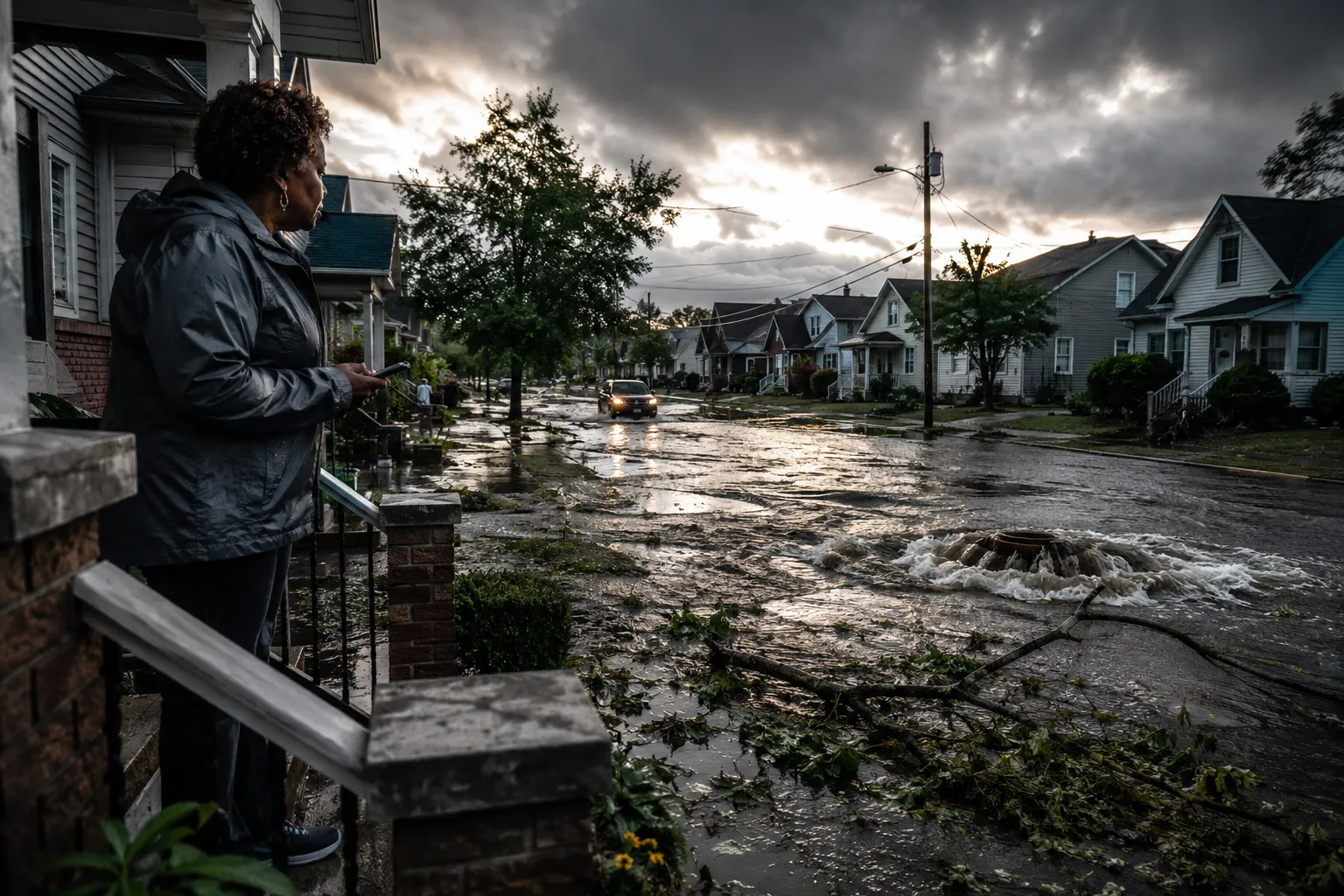
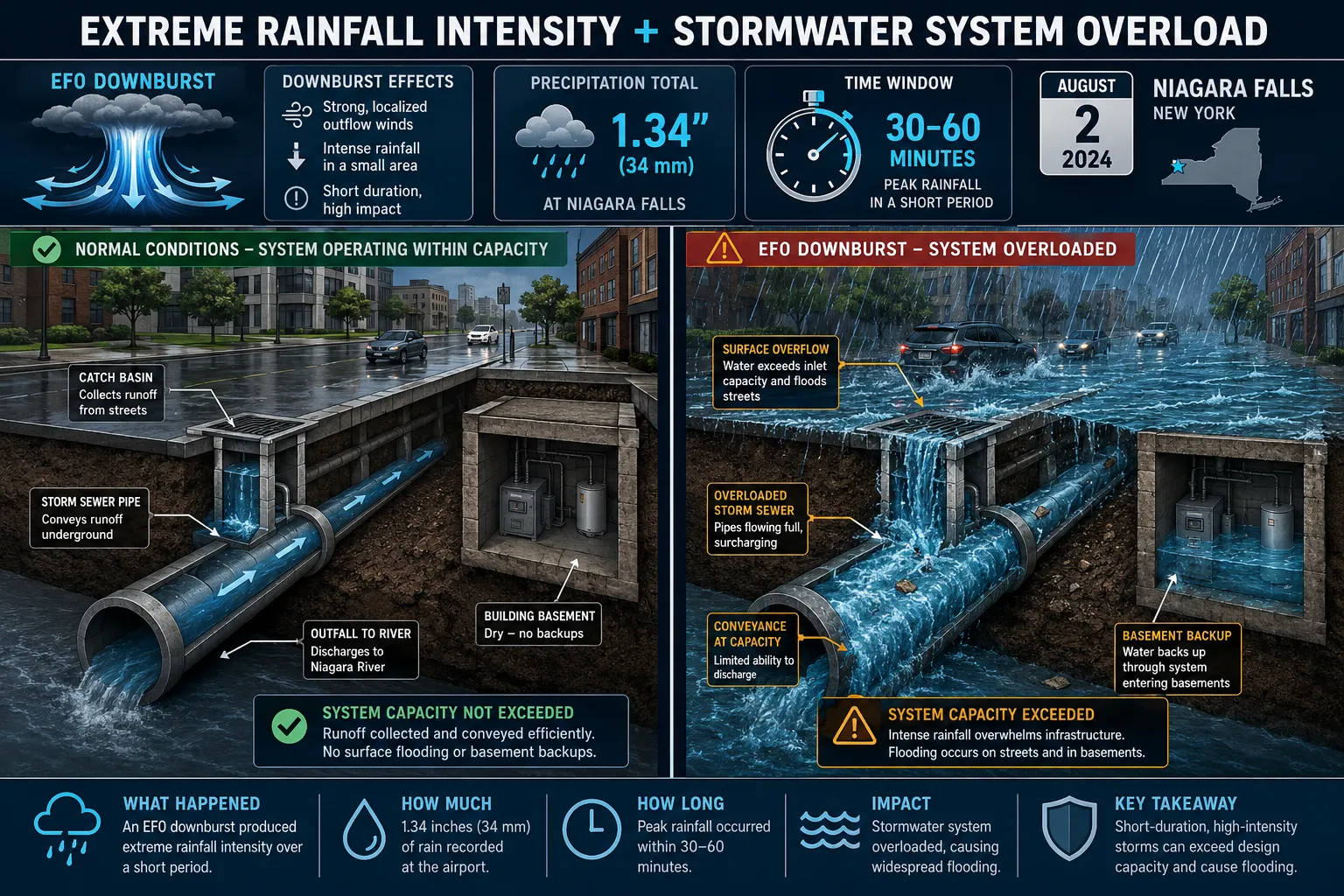
On August 2, 2026, a powerful storm system moved through the Niagara region, bringing intense rainfall, high winds, and localized flooding that affected thousands of residents and businesses. The storm struck quickly, overwhelming drainage infrastructure and causing water to surge into basements, ground-floor properties, and low-lying streets across Niagara Falls, St. Catharines, Lincoln, and surrounding communities. [10]
Western University’s Northern Tornadoes Project conducted a post-event survey and confirmed that an EF0 downburst struck the Niagara region on August 2, 2026. A downburst is a strong downdraft of air from a thunderstorm that spreads outward at ground level, capable of producing wind damage similar to a weak tornado. [7] The EF0 classification indicates wind speeds in the range of 105-137 km/h, strong enough to down trees, damage rooftops, and strip siding from structures.
On the U.S. side of the border, social media reports documented water rescue operations on College Avenue in Niagara Falls, New York, where bystanders assisted individuals stranded by rapidly rising water. [4] The storm’s impact was clearly cross-border, affecting both the Canadian and American sides of the Niagara River corridor.
Key facts about the August 2 storm:
- Classified as an EF0 downburst by Western University’s Northern Tornadoes Project [7]
- Affected multiple Niagara municipalities including Niagara Falls, St. Catharines, and Lincoln [9]
- Caused water rescues on the U.S. side of the border [4]
- Triggered states of emergency in St. Catharines and Lincoln [9]
- Prompted the City of Niagara Falls to launch a formal recovery registry within 48 hours [1]
What Caused the August 2 Niagara Falls Flooding
The flooding resulted from a combination of extreme rainfall intensity and the physical characteristics of the storm system. The confirmed EF0 downburst produced both heavy precipitation and strong winds in a short time window, which overwhelmed stormwater systems not designed to handle that volume of water so rapidly. [7]
Niagara’s geography plays a role as well. The region sits along the Niagara Escarpment, and water flows quickly from higher elevations toward the lower-lying urban core. When rainfall exceeds the absorption and drainage capacity of the land and infrastructure, surface flooding follows within minutes. Older urban areas with aging pipe networks are particularly vulnerable during high-intensity events.
More FM reported that Mother Nature had already tested the Niagara region earlier in the season, suggesting the August 2 event was part of a pattern of increasingly intense summer storm activity in the area. [6] Climate scientists have noted that the Great Lakes region is experiencing more frequent high-intensity rainfall events, though attribution of any single storm to long-term climate trends requires careful analysis.
How Bad Was the Niagara Falls Flood Damage
The flood damage across the Niagara region was significant enough to trigger formal states of emergency in multiple municipalities. St. Catharines and Lincoln remained under declared states of emergency as of the days following the storm, with regional officials coordinating a multi-agency response. [9]
Acting Regional Chair Insinna confirmed publicly that flood cleanup across the Niagara region would take several weeks to complete, signaling the scale of the damage was beyond what a standard municipal cleanup could address in days. [3] Residential basements, ground-floor commercial spaces, roadways, and green spaces all sustained damage.
Documented impacts include:
- Widespread basement flooding across residential neighbourhoods [10]
- Road closures and infrastructure damage in multiple municipalities [9]
- Downed trees and structural damage from the downburst winds [7]
- Water rescues required in Niagara Falls, New York [4]
- Overwhelming of municipal waste and debris management systems, prompting the special registry [1]
- Declared states of emergency in St. Catharines and Lincoln [9]
CBC News reported on the flooding conditions across the Hamilton-Niagara corridor, documenting the extent of water intrusion into homes and the challenges residents faced in the immediate aftermath. [8] [10]
Which Areas of Niagara Falls Were Most Affected
The storm’s damage was not evenly distributed. Lower-lying residential neighbourhoods, areas near drainage channels, and communities with older stormwater infrastructure experienced the worst flooding. Across the broader Niagara region, St. Catharines and Lincoln were the hardest-hit municipalities, both remaining under states of emergency in the storm’s aftermath. [9]
Within Niagara Falls itself, the city’s rapid launch of the Flood Recovery Support Registry on August 4 suggests a substantial number of households were affected, enough to require a coordinated, city-managed waste and resource response. [1] Niagara-on-the-Lake also issued public guidance to residents about managing floodwater, contacting insurers, and using pumps and shop vacuums to remove water safely, indicating that community too experienced notable flooding. [2]
On the U.S. side, Niagara Falls, New York saw flooding severe enough to require water rescue operations. [4]
Communities with confirmed significant impact:
- Niagara Falls, Ontario (formal registry launched) [1]
- St. Catharines (state of emergency declared) [9]
- Lincoln (state of emergency declared) [9]
- Niagara-on-the-Lake (public flood guidance issued) [2]
- Niagara Falls, New York (water rescues conducted) [4]
Niagara Falls Flood Recovery Efforts Underway: The Support Registry Explained
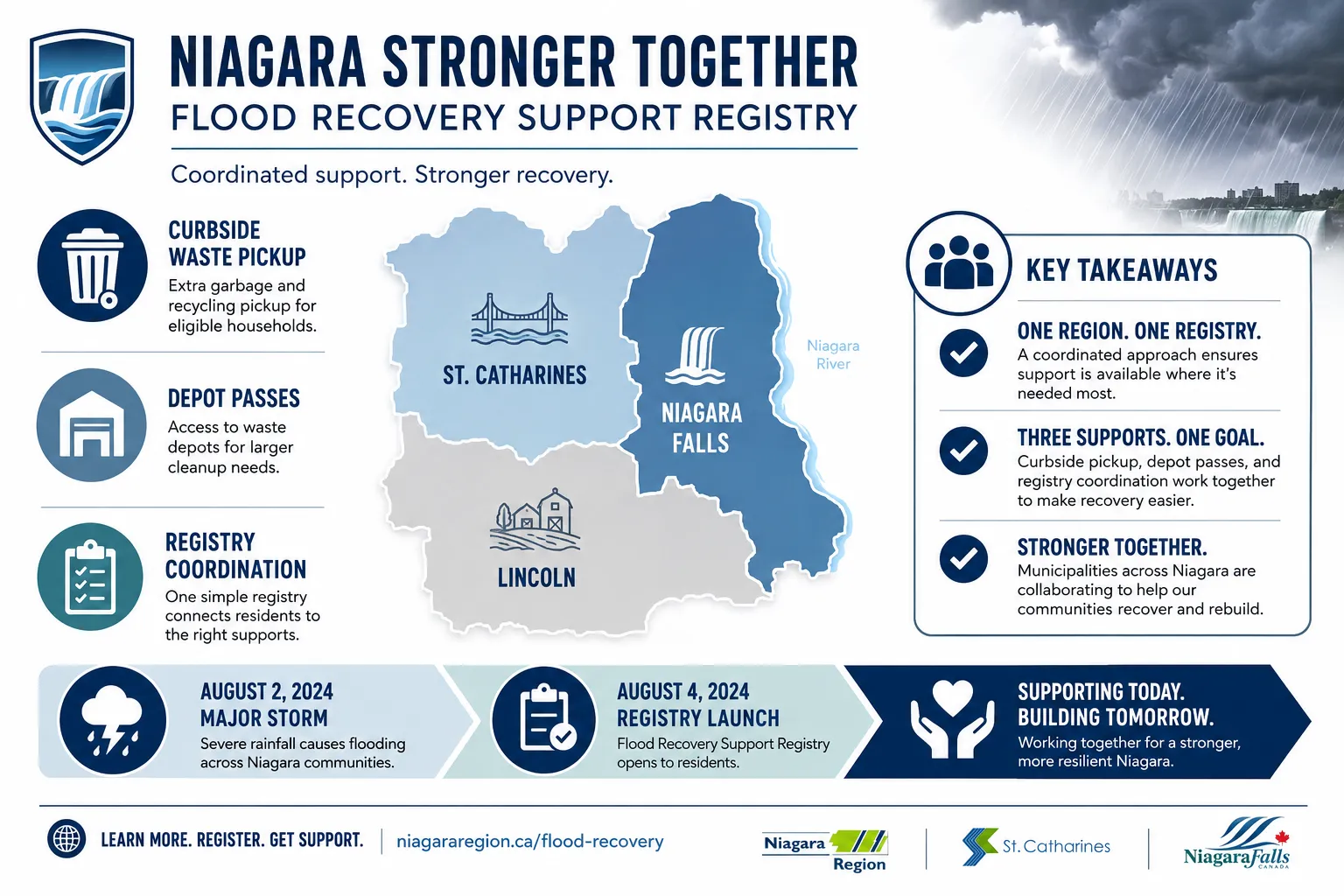
The City of Niagara Falls launched its Flood Recovery Support Registry on August 4, 2026, making it one of the fastest formal municipal responses to a storm event in the region’s recent history. The registry is the central coordination tool for the Niagara Falls flood recovery efforts underway after the August 2 storm, connecting affected residents with waste collection services and disposal resources. [1]
What the registry provides:
- Coordination of a special curbside collection of flood-related waste on Monday, August 10, 2026 [1]
- Waste drop-off passes for participating Niagara Region public waste depots [1]
- A centralized point of contact for residents needing disposal support for flood-damaged materials [1]
Who is eligible: Any Niagara Falls resident whose home was impacted by the August 2 flooding is eligible to register. The registry is specifically designed for residential properties dealing with flood-related waste, including waterlogged furniture, damaged drywall, flooring, appliances, and other materials that cannot go through regular curbside collection.
How to register:
- Online: Through the City of Niagara Falls website at niagarafalls.ca
- By phone: Call “At Your Service Niagara Falls” at 905-356-7521 (note: higher-than-normal call volumes expected) [1]
- In person: City Hall or the MacBain Community Centre [1]
Registration deadline: 3:00 p.m. on Friday, August 7, 2026, to allow the city to plan the August 10 collection route. [1]
“Registration is mandatory to receive services.”, City of Niagara Falls, August 4, 2026 [1]
This point is critical: residents who did not register by the deadline will not receive the August 10 curbside collection service, though waste depot passes may still be available through other channels.
How to Get Financial Aid After the Niagara Falls Flood
The most immediate financial step for affected residents is contacting their insurance provider. The City of Niagara Falls explicitly advises residents to reach out to their insurer as soon as possible and to document all damage with photos or video before beginning any cleanup work, provided it is safe to do so. [1] This documentation is essential for supporting insurance claims.
Niagara-on-the-Lake issued similar guidance, reinforcing that reporting flooding to insurers and photographing all damage before cleanup is standard best practice across the region. [2]
Steps to access financial assistance:
- Document everything first. Photograph and video all flood damage before moving or discarding any items. Include structural damage, waterlogged belongings, and any visible mould beginning to form.
- Contact your insurance provider immediately. Report the claim and ask specifically about coverage for overland flooding, sewer backup, and contents damage.
- Register with the City’s support registry (for waste removal assistance). [1]
- Check provincial and federal disaster relief programs. Ontario’s Disaster Recovery Assistance for Ontarians (DRAO) program can provide financial assistance to residents and small businesses when a disaster is declared eligible. Check ontario.ca for current program status related to the August 2 event.
- Contact your municipality’s social services department if you have been displaced or require emergency housing support.
Niagara Falls Flood Insurance Coverage: What Is Included
Standard home insurance policies in Canada do not automatically cover all types of flood damage, and this is a common source of confusion after events like the August 2 storm. Coverage depends on the specific policy and add-ons a homeowner has purchased.
Common coverage categories:
| Coverage Type | Typically Included | Usually Requires Add-On |
|---|---|---|
| Sewer backup | Sometimes | Often requires endorsement |
| Overland flooding | Rarely in older policies | Overland water add-on needed |
| Wind/storm damage to structure | Usually included | Check policy limits |
| Contents damage from flooding | Depends on cause | Verify with insurer |
| Additional living expenses (displacement) | Often included | Subject to limits |
The Insurance Bureau of Canada recommends that homeowners in flood-prone areas specifically ask about overland water coverage and sewer backup endorsements when reviewing their policies. If you are unsure what your policy covers, call your broker before filing to understand what documentation you will need.
Common mistake: Many residents begin cleanup and discard damaged materials before documenting them. Insurers require evidence of damage to process claims. Always photograph everything first. [1]
How to File a Claim for Flood Damage in Niagara Falls
Filing a flood damage claim in Ontario follows a standard process, but acting quickly improves outcomes. The City of Niagara Falls and Niagara-on-the-Lake both emphasized contacting insurers promptly as a first step. [1] [2]
Step-by-step claim process:
- Call your insurer or broker as soon as possible. Most insurers have 24-hour claims lines for disaster events.
- Get a claim number and the name of your claims adjuster.
- Submit your documentation, photos, videos, receipts for damaged items, and any repair estimates you have gathered.
- Do not make permanent repairs until the adjuster has assessed the damage, unless temporary repairs are needed to prevent further loss (such as tarping a damaged roof).
- Keep all receipts for emergency expenses, temporary accommodation, and cleanup costs, these may be reimbursable.
- Follow up regularly. After a major regional event, insurers handle high claim volumes. Staying in contact with your adjuster keeps your file active.
If your claim is denied or you believe the settlement is insufficient, you can contact the General Insurance OmbudService (GIO) in Ontario for independent dispute resolution.
Niagara Falls Flood Cleanup Services Available
Beyond the city’s official registry, several types of cleanup support are available to affected residents. The Niagara Falls flood recovery efforts underway after the August 2 storm include both municipal services and private sector options.
Municipal and regional services:
- City of Niagara Falls special curbside collection on August 10 (registration required by August 7 at 3:00 p.m.) [1]
- Waste drop-off passes for Niagara Region public depots [1]
- Regional coordination through Niagara Region municipal offices [9]
Private cleanup services: Licensed water damage restoration companies operate throughout the Niagara region and can provide services including water extraction, structural drying, mould remediation, and contents restoration. When selecting a contractor:
- Verify they hold a valid Ontario business licence
- Ask for written estimates before work begins
- Confirm they have experience with insurance-related documentation
- Be cautious of door-to-door solicitors following a disaster, price gouging after emergencies is illegal in Ontario
Self-help guidance from municipalities: Niagara-on-the-Lake advised residents to use pumps or shop vacuums to remove standing water safely, ensure electrical systems are off before entering flooded spaces, and allow adequate ventilation to reduce mould risk. [2] These basic steps apply equally to Niagara Falls residents.
Niagara Falls Flood Recovery Timeline: How Long Will It Take
Cleanup across the Niagara region will take several weeks, according to Acting Regional Chair Insinna. [3] The timeline varies significantly depending on the severity of individual property damage, insurance processing speed, and availability of contractors.
General recovery phases:
- Immediate (Days 1-7): Emergency water removal, documentation, waste registration, temporary repairs to prevent further damage.
- Short-term (Weeks 1-4): Structural drying, mould assessment, debris removal, insurance adjuster visits, initial repair estimates.
- Medium-term (Weeks 4-12): Structural repairs, drywall replacement, flooring installation, appliance replacement.
- Long-term (3-12 months): Full restoration of severely damaged properties, resolution of complex insurance claims, infrastructure repairs by the municipality.
For residents whose damage was limited to basement flooding and contents loss, recovery can realistically be completed within four to eight weeks if insurance proceeds are received promptly. For properties with structural damage or mould, the timeline extends considerably.
The city’s August 10 curbside collection is the first concrete milestone in the municipal recovery timeline, designed to clear flood-damaged waste from properties quickly so cleanup can proceed. [1]
Where to Donate to Niagara Falls Flood Relief
Residents and businesses outside the affected areas who want to support flood relief can contribute through several channels. While the City of Niagara Falls has not announced a specific municipal donation fund as of this writing, established regional and national organizations typically mobilize after declared disaster events.
Donation options to consider:
- Canadian Red Cross: Regularly active in Ontario disaster relief; check redcross.ca for any active Niagara region appeal.
- Local food banks: Displaced residents often rely on food banks in the weeks following a flood. The Niagara Falls Community Outreach and local food banks welcome non-perishable donations and financial contributions.
- Community foundations: The Niagara Community Foundation may establish a dedicated flood relief fund; check their website for current campaigns.
- Direct neighbour support: Practical assistance such as helping neighbours with debris removal, providing meals, or offering temporary accommodation is equally valuable.
When donating to any organization, verify their charitable registration number through the Canada Revenue Agency’s charity registry to ensure your donation is legitimate and tax-deductible.
Are Niagara Falls Attractions Reopening After the Flood
The iconic Niagara Falls themselves were not damaged by the August 2 storm, the waterfalls continue to flow as always, and the Canadian side remains one of the most visited natural attractions in North America. However, some surrounding infrastructure and access routes experienced temporary disruptions in the storm’s immediate aftermath.
As of the days following the event, major attractions including the Niagara City Cruises boat experience, the Journey Behind the Falls, and the Skylon Tower were continuing to operate or in the process of resuming normal operations. Visitors are advised to check directly with individual attractions for current operating status before visiting.
For travellers planning a trip to Niagara Falls from Toronto, the falls and their core attractions remain accessible. The Toronto to Niagara Falls Tour with Boat Cruise offered by BG Tours Canada continues to provide a premium, guided experience that includes the boat cruise, Journey Behind the Falls, and expert commentary on the region’s history and geology. BG Tours’ knowledgeable guides are well-positioned to provide visitors with current on-the-ground context about the area’s recovery.
Travellers curious about the best way to reach Niagara Falls from Toronto can also review the complete guide to getting from Toronto to Niagara Falls for shuttle, train, rideshare, and guided tour options compared side by side.
Can I Visit Niagara Falls After the August 2 Storm
Yes, visiting Niagara Falls remains possible and worthwhile after the August 2 storm. The falls themselves are unaffected, and the primary tourist corridors on the Canadian side are accessible. Visitors should exercise normal caution in areas where cleanup is still underway and follow any posted municipal advisories about specific road closures or restricted zones.
For those planning a day trip, BG Tours Canada’s Toronto to Niagara Falls Day Trip Itinerary for 2026 provides a practical framework for making the most of a visit, including timing, attraction sequencing, and what to expect at each stop.
The Niagara Falls Crowd Guide is also a useful resource for understanding peak and off-peak visiting patterns, which may shift slightly in the weeks following the storm as some local visitors focus on recovery rather than tourism.
If you are travelling from Toronto Pearson Airport directly to Niagara Falls, the stress-free guide from Toronto Airport to Niagara Falls covers transport options, timing, and what to book in advance.
Niagara Falls Flood Prevention: What Is Being Done Differently
The August 2 storm has renewed focus on flood prevention and infrastructure resilience across the Niagara region. Acting Regional Chair Insinna’s acknowledgment that cleanup would take weeks signals that regional leadership is engaged at the highest level. [3] Longer-term, municipalities across Ontario are under increasing pressure to upgrade stormwater infrastructure to handle more intense rainfall events.
Current and likely future prevention measures:
- Stormwater infrastructure review: Following major flood events, municipalities typically commission engineering assessments of drainage capacity and identify upgrade priorities.
- Updated flood mapping: The Conservation Authority of Ontario updates flood plain maps periodically; the August 2 event may prompt accelerated reviews of risk zones in the Niagara area.
- Residential flood-proofing programs: Some Ontario municipalities offer rebates for homeowners who install backwater valves, sump pumps, or other flood-proofing measures. Niagara Falls residents should check the city’s website for any new programs launched in response to the August 2 event.
- Public education: Municipalities including Niagara-on-the-Lake issued detailed public guidance during the event, a sign that communication infrastructure for future events is being strengthened. [2]
The EF0 downburst classification from Western University’s Northern Tornadoes Project also provides valuable data for future severe weather preparedness planning in the region. [7]
Niagara Falls Flood Compared to Previous Disasters
The August 2, 2026, flood is notable for its speed of onset and the breadth of its municipal impact, but the Niagara region has experienced significant flood events before. Comparing this event to previous disasters helps put the current recovery in context.
The Niagara region has historically been vulnerable to spring flooding from snowmelt and ice jams along the Niagara River, as well as summer storm flooding from intense convective rainfall. The August 2 event falls into the latter category, driven by the confirmed downburst rather than prolonged rainfall over days.
What distinguishes the August 2, 2026, event from many past storms is the formal declaration of states of emergency in multiple municipalities simultaneously [9], the rapid launch of a dedicated city registry within 48 hours [1], and the cross-border nature of the flooding affecting both Ontario and New York. The regional coordination response, with the Acting Regional Chair making public statements about the multi-week cleanup timeline [3], reflects a more structured emergency management approach than was common in earlier decades.
For historical context, the Niagara region experienced significant flooding in 2017 and 2019 related to high Lake Ontario water levels, though those events were driven by sustained high water rather than a single storm system. The August 2, 2026, event is more comparable to intense summer convective storms that have affected Southern Ontario in recent years.
Frequently Asked Questions
What is the Niagara Falls Flood Recovery Support Registry? The Flood Recovery Support Registry is a program launched by the City of Niagara Falls on August 4, 2026, to coordinate special curbside waste collection and waste depot passes for residents whose homes were flooded on August 2, 2026. Registration is mandatory to receive services. [1]
When was the registration deadline for the August 10 curbside collection? The registration deadline was 3:00 p.m. on Friday, August 7, 2026. Residents who missed this deadline should contact the city directly at 905-356-7521 to ask about alternative disposal options. [1]
How do I register for the Niagara Falls flood recovery support? You can register online at niagarafalls.ca, by phone at 905-356-7521, or in person at City Hall or the MacBain Community Centre in Niagara Falls. [1]
What caused the flooding in Niagara Falls on August 2? Western University’s Northern Tornadoes Project confirmed an EF0 downburst struck the Niagara region on August 2, 2026, producing intense rainfall and high winds that overwhelmed drainage systems. [7]
Which municipalities declared states of emergency after the August 2 storm? St. Catharines and Lincoln declared states of emergency. Niagara Falls launched a formal recovery registry, and Niagara-on-the-Lake issued public flood guidance. [9] [2]
How long will flood cleanup take in Niagara Falls? Acting Regional Chair Insinna stated that cleanup across the Niagara region will take several weeks. Individual property timelines depend on damage severity and insurance processing speed. [3]
Should I clean up before the insurance adjuster visits? Document all damage with photos and video first, then begin emergency cleanup to prevent further damage (such as mould growth). Do not make permanent repairs until the adjuster has assessed the property. Keep all receipts. [1]
Is Niagara Falls still open to tourists after the August 2 storm? Yes. The falls and major attractions remain accessible. Some surrounding infrastructure experienced temporary disruptions, so check with specific attractions for current operating hours before visiting.
Does standard home insurance cover flood damage in Ontario? Standard policies often do not cover overland flooding. Sewer backup and overland water coverage typically require separate endorsements. Contact your insurer or broker to clarify your specific coverage.
Where can I get help if I was displaced by the Niagara Falls flood? Contact the City of Niagara Falls social services department, the Canadian Red Cross, or local community organizations. The city’s “At Your Service” line at 905-356-7521 can direct you to appropriate resources. [1]
Can I still book a Niagara Falls tour from Toronto? Yes. BG Tours Canada continues to operate guided tours from Toronto to Niagara Falls. The Niagara Falls Tour featuring the Boat Cruise, Journey Behind the Falls, and Tower Tour remains available for booking.
What is an EF0 downburst? An EF0 downburst is a strong downdraft of air from a thunderstorm that spreads outward at ground level, producing wind speeds of approximately 105-137 km/h. It can cause tree damage, structural damage, and intense localized rainfall. The August 2 Niagara event was classified as EF0 by Western University’s Northern Tornadoes Project. [7]
Conclusion
The Niagara Falls flood recovery efforts underway after the August 2 storm represent one of the most coordinated municipal responses the region has seen following a single storm event. Within 48 hours of the flooding, the City of Niagara Falls had launched a formal Flood Recovery Support Registry, established a special curbside collection date, and opened multiple registration channels for affected residents. [1] Across the region, St. Catharines and Lincoln remained under states of emergency, and the Acting Regional Chair confirmed that full cleanup would take several weeks. [3] [9]
Actionable next steps for affected residents:
- If you registered before the August 7 deadline, prepare flood-damaged waste for the August 10 curbside collection.
- If you missed the deadline, call 905-356-7521 to ask about depot passes and alternative disposal options.
- Contact your insurance provider now if you have not already, and submit your photo and video documentation.
- Check ontario.ca for the status of the provincial Disaster Recovery Assistance for Ontarians program.
- For ongoing updates, monitor niagarafalls.ca and the Niagara Region’s official communications channels.
For visitors and travellers, Niagara Falls remains one of Canada’s most spectacular destinations. The falls continue to flow, and the region’s tourism infrastructure is resilient. Whether you are planning a day trip from Toronto or a longer stay, BG Tours Canada’s expert guides bring unmatched knowledge of the area’s history, geology, and current conditions to every tour. Explore the full range of Niagara Falls tour packages to find the experience that fits your plans, and consider the 7 unique Niagara Falls tours to experience this summer for inspiration beyond the standard itinerary.
The Niagara community is recovering. And when you are ready to visit, it will be ready to welcome you.
References
[1] City Of Niagara Falls Launches Flood Recovery Support Registry – https://niagarafalls.ca/news/posts/city-of-niagara-falls-launches-flood-recovery-support-registry/
[2] Community Update Flooding Recovery Efforts Continue – https://www.notl.com/recreation-community/community-news/community-update-flooding-recovery-efforts-continue
[3] Niagara Flood Cleanup Will Take Weeks Says Acting Regional Chair Insinna – https://forterieradio.ca/niagara-flood-cleanup-will-take-weeks-says-acting-regional-chair-insinna/
[5] CBC.ca – https://www.cbc.ca/lite/story/9.7294327
[6] Mother Nature Hits Niagara Again – https://www.morefm.ca/news/local-news/mother-nature-hits-niagara-again/
[7] EF0 Downburst In Niagara Region On Aug 2 – https://www.uwo.ca/ntp/blog/2026/ef0_downburst_in_niagara_region_on_aug_2.html
[8] Ont Niagara Floods 9 – https://www.cbc.ca/news/canada/hamilton/ont-niagara-floods-9.7298113
[9] Niagara Region Ramps Up Flood Recovery Efforts As Lincoln St Catharines Remain Under States Of Emergency – https://www.chch.com/chch-news/niagara-region-ramps-up-flood-recovery-efforts-as-lincoln-st-catharines-remain-under-states-of-emergency/
[10] Flooding Niagara Storm 9 – https://www.cbc.ca/news/canada/hamilton/flooding-niagara-storm-9.7288289



