

Last updated: May 29, 2026
Quick Answer
Toronto and Niagara Falls together form one of the most accessible and rewarding first-time Canada itineraries available. Toronto is Canada’s largest city, offering world-class food, culture, and entertainment, while Niagara Falls — roughly 130 km away — delivers one of the most spectacular natural wonders on earth. Most first-timers can cover both destinations comfortably in 4 to 7 days.
Key Takeaways
- Best months to visit: June through September for warm weather; January through March for winter festivals and lower prices
- Budget estimate: Expect CAD $150–$250 per person per day in Toronto, covering accommodation, food, transit, and entry fees
- Visa requirements: U.S. citizens do not need a visa but must carry a valid passport; most other nationalities need an eTA or visitor visa
- Toronto to Niagara travel time: Approximately 1.5 to 2 hours by car, GO Transit, or guided coach tour
- Niagara Falls free viewing: The falls are visible for free from Queen Victoria Park and several public lookout points along the Niagara Parkway
- Must-try Toronto foods: Peameal bacon sandwich, butter tarts, poutine, and Toronto’s famous diverse food hall scene
- Kid-friendly highlights: CN Tower EdgeWalk (ages 13+), Ripley’s Aquarium, Niagara boat cruise, and Journey Behind the Falls
- Safety: Toronto consistently ranks among the safest major cities in North America for solo travelers
- Biggest first-timer mistake: Underestimating travel time between attractions and skipping a guided tour to Niagara
- Top tour option: A full-day guided tour from Toronto covering the boat cruise, Journey Behind the Falls, and Skylon Tower gives the best value per hour
What Are the Best Months to Visit Toronto and Niagara?
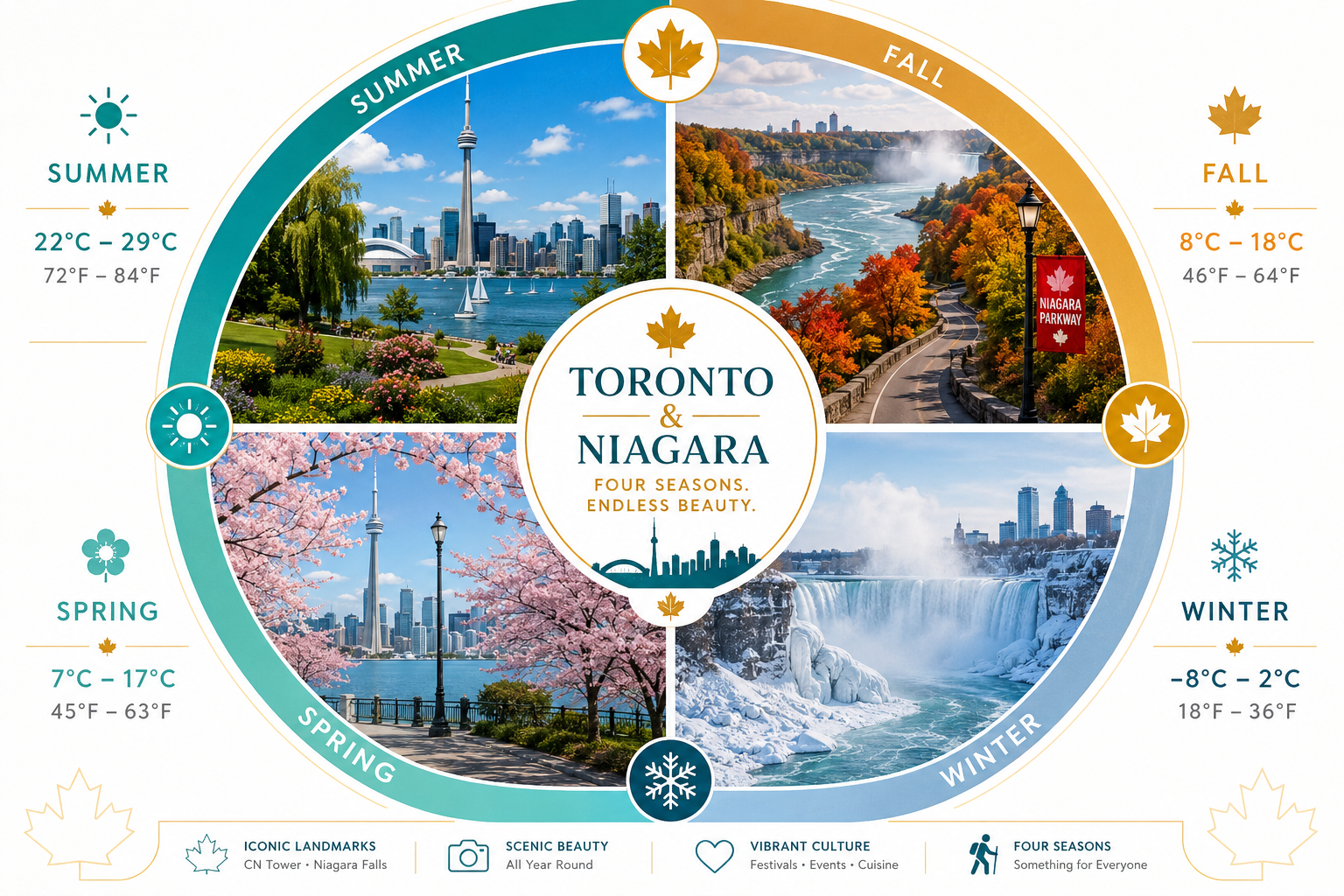
June through September is the peak season for visiting Toronto and Niagara Falls, offering warm temperatures, all attractions in full operation, and the longest daylight hours. That said, each season has a strong case depending on what a traveler wants.
Season-by-season breakdown
| Season | Months | Toronto Temp | Niagara Highlights | Crowd Level |
|---|---|---|---|---|
| Spring | April–May | 8°C–18°C | Tulip blooms, lower prices | Moderate |
| Summer | June–Sept | 20°C–30°C | All attractions open, festivals | High |
| Fall | Oct–Nov | 5°C–15°C | Foliage on Niagara Parkway | Moderate |
| Winter | Dec–March | -10°C to 0°C | Winter Festival of Lights, ice formations | Low |
Summer gives the full experience: the Niagara City Cruises boat tour runs at full capacity, Journey Behind the Falls is open, and Toronto’s outdoor patios and waterfront are buzzing. Book accommodations and tours well in advance, especially for July and August.
Winter is surprisingly compelling at Niagara. The falls don’t freeze completely, but ice formations build up along the edges, creating a dramatic look. The Winter Festival of Lights draws significant crowds from November through January. Prices for hotels and tours drop noticeably.
Choose summer if you want maximum access to every attraction. Choose January–February if you want lower costs, thinner crowds, and a genuinely unique view of the falls.
How Cold Does It Get in Toronto During Winter?
Toronto winters are genuinely cold. Average temperatures in January sit around -6°C (21°F), with wind chill regularly pushing the feels-like temperature below -15°C (5°F). Snowfall is common from December through February.
That said, Toronto’s underground PATH network — one of the world’s largest underground pedestrian systems — connects over 30 km of shops, restaurants, and transit hubs, so it’s entirely possible to spend most of a winter day indoors without stepping outside.
What to pack for winter:
- Insulated, waterproof boots (essential)
- A heavy coat rated for -20°C
- Thermal base layers
- Gloves, scarf, and a hat that covers the ears
- Wool or moisture-wicking socks
At Niagara in winter, the mist from the falls makes the walkways icy and the air biting. Waterproof outerwear is non-negotiable.
How Much Does a Trip to Toronto Cost for a Week?
A week in Toronto with a day trip to Niagara typically costs CAD $1,500–$2,500 per person, depending on accommodation choices, dining habits, and which attractions are included. Toronto welcomed 28.2 million visitors in 2025, generating $9.1 billion in direct spending — which reflects how much visitors invest in the city [1].
Estimated weekly budget breakdown (per person, CAD)
| Category | Budget Traveler | Mid-Range | Premium |
|---|---|---|---|
| Accommodation (7 nights) | $490–$700 | $840–$1,400 | $1,750+ |
| Food & drink | $175–$280 | $350–$560 | $700+ |
| Toronto attractions | $50–$100 | $100–$200 | $200+ |
| Niagara day trip (guided) | $110–$150 | $150–$225 | $225+ |
| Local transit | $50–$80 | $80–$120 | $100–$200 |
| Total (approx.) | $875–$1,310 | $1,520–$2,505 | $2,975+ |
Practical money tips:
- The Toronto Presto card covers all TTC subway, bus, and streetcar rides at a flat fare
- Many Toronto museums offer free or discounted admission on specific evenings
- Eating in Kensington Market or St. Lawrence Market costs far less than tourist-zone restaurants
- Booking a guided Niagara tour package bundles transport, entry fees, and expertise into one competitive price — often cheaper than piecing it together independently
Do I Need a Visa to Visit Canada from the US (and Other Countries)?
U.S. citizens do not need a visa to enter Canada but must present a valid U.S. passport at the border. A driver’s license alone is not sufficient for air travel, though it may be accepted at land crossings.
For most other nationalities, the requirement is either an Electronic Travel Authorization (eTA) or a full Visitor Visa (Temporary Resident Visa):
- eTA required: Citizens of the UK, Australia, France, Germany, Japan, South Korea, and most other visa-exempt countries traveling by air. An eTA costs CAD $7 and is applied for online through the Government of Canada website. Most approvals arrive within minutes, though some take several days.
- Visitor Visa required: Citizens of countries not on the visa-exempt list, including India, China, Philippines, and many others. Apply through the IRCC (Immigration, Refugees and Citizenship Canada) portal well in advance — processing times vary from a few weeks to several months.
Common mistake: Travelers from visa-exempt countries sometimes assume their passport is enough for air travel to Canada. It isn’t — the eTA must be linked to the passport before boarding.
What’s the Difference Between Toronto and Niagara Attractions?
Toronto and Niagara Falls offer completely different types of experiences, and most first-timers benefit from spending time in both rather than choosing one over the other.
Toronto is a metropolitan destination built around culture, food, architecture, and urban energy. Niagara Falls is a natural wonder destination where the landscape itself is the main event.
Toronto’s top attractions
- CN Tower — 553 metres tall, with a glass floor and the EdgeWalk experience
- Ripley’s Aquarium of Canada — one of North America’s best, located at the base of the CN Tower
- Royal Ontario Museum (ROM) — world-class natural history and art collections
- Distillery District — Victorian industrial architecture converted into galleries, restaurants, and boutiques
- St. Lawrence Market — a working market named one of the world’s best by National Geographic
- Toronto Islands — a quick ferry ride to car-free islands with beaches and skyline views
Niagara Falls’ top attractions
- Horseshoe Falls — the Canadian falls, the largest and most powerful of the three falls
- Niagara City Cruises (boat tour) — gets visitors within meters of the falling water
- Journey Behind the Falls — tunnels cut 125 feet into the rock behind the curtain of water
- Skylon Tower — revolving restaurant and observation deck with panoramic views of both the Canadian and American sides
- Niagara Takes Flight — a $25 million flying theatre experience opened in August 2025 [4]
- Niagara-on-the-Lake — a charming 19th-century town with wineries and heritage architecture, drawing approximately 3.5 million visitors annually [5]
For a deeper look at planning the Niagara portion of the trip, the Ultimate Guide to Niagara Falls Excursions from Toronto covers the full range of options in detail.
Can I See Niagara Falls for Free?
Yes — the falls themselves are free to view. Queen Victoria Park, which runs along the Canadian side of the Niagara River, offers unobstructed views of both Horseshoe Falls and the American Falls at no cost. The Niagara Parkway is a public road with multiple free pullouts and viewpoints.
What costs money:
- Niagara City Cruises boat tour (approximately CAD $35–$40 per adult)
- Journey Behind the Falls (approximately CAD $30–$35 per adult)
- Skylon Tower observation deck (approximately CAD $20–$30 per adult)
- Niagara Takes Flight flying theatre (check current pricing at the Niagara Parks Commission)
Free things at Niagara:
- Walking along the Niagara Parkway and Table Rock Welcome Centre viewing area
- Watching the falls illumination at night (seasonal, free from public areas)
- Exploring the Niagara Gorge trails
- Visiting the Floral Clock and Butterfly Conservatory grounds
For most first-timers, skipping the paid attractions entirely means missing what makes Niagara genuinely memorable. The boat cruise, in particular, is a non-negotiable experience — the scale of the falls only becomes real when you’re standing in the mist 50 meters away.
What Are the Cheapest Ways to Travel Between Toronto and Niagara?
The most affordable way to get from Toronto to Niagara Falls is by GO Transit, Ontario’s regional public transit system. GO offers weekend service on the Lakeshore West line with connections to Niagara Falls station, and the GO+WEGO combo ticket provides seamless hop-on, hop-off access to major tourist areas once in Niagara [3].
Toronto to Niagara transport options compared
| Option | Cost (approx.) | Travel Time | Convenience |
|---|---|---|---|
| GO Transit (weekend) | CAD $15–$25 return | 2–2.5 hrs | Moderate |
| Megabus / FlixBus | CAD $10–$35 return | 2–2.5 hrs | Moderate |
| Guided day tour | CAD $110–$225 | 9 hrs (full day) | High |
| Rental car | CAD $60–$120/day + parking | 1.5 hrs | High (but costly) |
| Rideshare (Uber) | CAD $80–$130 one way | 1.5 hrs | Low value |
The case for a guided tour: While GO Transit is cheaper upfront, a guided tour bundles return transport, expert commentary, skip-the-line access to attractions, and often includes entry fees. For a first-timer who doesn’t want to figure out WEGO bus routes or stand in long queues, the value math often favors a tour. See the detailed comparison at Niagara Falls Tour vs Self-Drive from Toronto for a full breakdown.
BG Tours Canada’s Toronto to Niagara Falls packages start at $110 per adult for a 9-hour day that includes transport in an air-conditioned coach and guided access to the falls. The Toronto to Niagara Falls Tour with Boat Cruise, Journey Behind the Falls, and Skylon Tower at $150 per adult adds all three premium experiences in a single day.
For those considering the solo travel angle, Niagara Falls Bus Tours for Solo Travelers explains why group tours are particularly well-suited for travelers going it alone.
What Should I Pack for a Canadian Trip in Summer?
Summer packing for Toronto and Niagara is straightforward, but a few specifics make a real difference in comfort, especially at the falls.
Essential summer packing list:
- Lightweight, waterproof jacket — Niagara’s mist soaks clothing quickly; a poncho is provided on the boat cruise but a jacket is useful elsewhere
- Comfortable walking shoes — both Toronto and Niagara involve significant walking on varied terrain
- Sunscreen (SPF 30+) — summer UV index in Ontario regularly hits 7–9
- Insect repellent — useful near the Niagara Gorge trails and Toronto Islands
- Reusable water bottle — tap water in both cities is safe and clean
- Light layers — Toronto evenings can drop to 15°C even in July
- Valid ID and travel documents — keep passport accessible, especially at the US-Canada border near Niagara
- Power adapter — Canada uses Type A/B outlets (same as the US; 120V/60Hz), so most US devices work without adapters; European and UK travelers need adapters
Niagara-specific: Wear clothes you don’t mind getting wet on boat tour days. Waterproof sandals or shoes with grip are useful on wet observation decks.

Which Attractions Are Kid-Friendly in Toronto and Niagara?
Both Toronto and Niagara Falls are exceptionally family-friendly destinations, with a wide range of activities suited to children of different ages.
Best kid-friendly attractions
Toronto:
- Ripley’s Aquarium of Canada — interactive touch tanks, shark tunnel, and jellyfish gallery; excellent for all ages
- CN Tower — the glass floor is a genuine thrill for older kids; EdgeWalk is for ages 13+
- Ontario Science Centre — hands-on science exhibits designed specifically for children
- Toronto Zoo — one of the largest zoos in the world, with over 5,000 animals
- Toronto Islands — beaches, bike rentals, and an amusement park (Centreville) for younger children
Niagara Falls:
- Niagara City Cruises — kids in ponchos on the boat cruise is a universally beloved family memory
- Journey Behind the Falls — the tunnel experience is dramatic and safe for children; minimum age recommendations apply for the outdoor observation points
- Butterfly Conservatory — calm, beautiful, and educational; ideal for younger children
- Niagara Takes Flight — the new flying theatre is designed for families and accessible to most ages [4]
- Clifton Hill — the entertainment strip with arcades, mini-golf, and attractions aimed directly at families
The Niagara Region attracts over 13 million tourists annually [2], and a significant portion of that number are families — meaning the infrastructure for family travel is well-developed.
How Safe Is Toronto for Solo Travelers?
Toronto is consistently ranked among the safest major cities in North America, and solo travelers — including solo women travelers — generally report feeling comfortable throughout most of the city.
Practical safety notes:
- The downtown core, Entertainment District, Distillery District, and waterfront are well-lit and heavily trafficked at all hours
- The TTC subway is generally safe; avoid empty cars late at night as a precaution
- Areas like Regent Park and parts of Jane-Finch have higher crime rates — these are not tourist areas and are easily avoided
- Petty theft (pickpocketing) occurs in crowded areas like Eaton Centre and the waterfront; keep bags zipped and valuables secured
- Emergency services: dial 911 for police, fire, or ambulance
For solo travelers heading to Niagara, a guided group tour is the recommended approach. It eliminates navigation stress, provides built-in social interaction, and ensures transport is handled. Niagara Falls Bus Tours for Solo Travelers covers what to look for in a solo-friendly operator.
What Food Is Toronto Famous For That I Must Try?
Toronto’s food scene is one of its defining features, shaped by over 200 nationalities calling the city home. No single cuisine dominates — which is exactly the point.
Must-try Toronto foods:
- Peameal bacon sandwich — a Toronto original, found at St. Lawrence Market; cured pork loin rolled in cornmeal, served on a kaiser bun
- Butter tarts — a Canadian pastry staple with a flaky shell and sweet, gooey filling; found in every bakery
- Poutine — fries, cheese curds, and gravy; the Canadian comfort food benchmark
- Jerk chicken — Toronto’s Caribbean community, particularly in the Little Jamaica neighborhood, serves some of the best in North America
- Dim sum — the Scarborough and North York neighborhoods have exceptional Cantonese dim sum restaurants
- Korean BBQ and Korean fried chicken — Koreatown on Bloor Street West is a destination in itself
- Vegan and plant-based food — Toronto has one of the most developed vegan dining scenes in Canada
Where to eat affordably:
- St. Lawrence Market (breakfast and lunch)
- Kensington Market (global street food)
- Scarborough (authentic South and East Asian cuisine at fraction of downtown prices)
Are There Any Tourist Scams I Should Watch Out for in Toronto?
Toronto is not a high-scam city, but a handful of situations catch first-timers off guard.
Common scams and how to avoid them:
- Overpriced “official” tours at Niagara: Some operators near Clifton Hill charge premium prices for basic transport with minimal guiding. Book tours in advance through reputable operators like BG Tours Canada to lock in transparent pricing and verified inclusions.
- Fake currency exchange booths: Always use bank ATMs or established currency exchange services. Avoid street-level or hotel lobby exchange counters with opaque fee structures.
- Taxi overcharging from Pearson Airport: Use the flat-rate taxi system (fixed fares to downtown Toronto are posted at the taxi stand) or book an Uber/Lyft before exiting arrivals.
- “Charity” solicitation: Individuals with clipboards near tourist areas sometimes pressure visitors into signing up for recurring donations. A firm “no thank you” is sufficient.
- Counterfeit event tickets: Buy tickets for concerts, sports events, and attractions directly from official websites or box offices.
General rule: If someone approaches you unsolicited with an offer that requires immediate payment, walk away.
What Are Common Mistakes First-Time Visitors Make in Canada?
The most common mistake first-timers make is treating Toronto and Niagara as a single-day experience. Both destinations deserve dedicated time, and rushing through either one means missing the best of what each offers.
Other frequent mistakes:
- Not booking Niagara attractions in advance — the boat cruise and Journey Behind the Falls sell out during peak summer weekends
- Underestimating distances within Toronto — the city is large; a walk from the CN Tower to the Distillery District looks short on a map but takes 25–30 minutes on foot
- Skipping the Canadian side of Niagara — the American side has views, but the Canadian side (Ontario) has the better vantage points, more attractions, and the full horseshoe view of the falls
- Ignoring the eTA requirement — visa-exempt international travelers who book flights without securing an eTA first can be denied boarding
- Driving to Niagara without a plan for parking — parking near the falls is expensive and limited in summer; a guided coach tour or GO Transit eliminates this entirely
- Exchanging currency at the airport — rates at airport booths are consistently poor; use a bank ATM after arrival
- Not packing for rain at Niagara — even on sunny days, the mist from the falls creates a localized wet zone around the observation areas
For a detailed day-by-day plan, the 1-Day Niagara Falls Itinerary from Toronto walks through exactly how to structure the Niagara portion of the trip, and the Toronto to Niagara Falls Day Trip Itinerary 2026 covers the most current timing and logistics.
FAQ: A First-Timer’s Guide to Visiting Canada — Toronto & Niagara
Q: How many days should I spend in Toronto before going to Niagara? A: Two to three days in Toronto gives enough time to cover the main attractions without rushing. Add one full day for Niagara Falls, and one day for Niagara-on-the-Lake if the itinerary allows.
Q: Is Niagara Falls worth visiting in winter? A: Yes. The ice formations are dramatic, crowds are thin, and prices drop significantly. The Winter Festival of Lights (November through January) adds a festive element. Most attractions remain open, though hours may be reduced.
Q: Can I walk across the border from Canada to the US at Niagara? A: Yes. The Rainbow Bridge connects Niagara Falls, Ontario to Niagara Falls, New York and is open to pedestrians. A valid passport is required, and standard border crossing rules apply in both directions.
Q: What currency is used in Canada? A: The Canadian dollar (CAD). Credit cards are accepted almost everywhere in Toronto and Niagara. Tipping 15–20% is standard at restaurants and for tour guides.
Q: Is the CN Tower worth the cost? A: For first-timers, yes. The observation deck provides an irreplaceable perspective on Toronto’s scale and Lake Ontario. The EdgeWalk is an optional add-on for those comfortable with heights.
Q: What is Journey Behind the Falls? A: It’s a Niagara Parks attraction where visitors descend 38 meters by elevator and walk through tunnels cut into the rock directly behind Horseshoe Falls. The observation portals put visitors within meters of the falling water. It’s one of the most unique experiences at Niagara and is included in several BG Tours Canada packages.
Q: How far is Niagara-on-the-Lake from Niagara Falls? A: Approximately 20 km (about 25 minutes by car). It’s a popular add-on to a Niagara day trip, known for its wineries, heritage main street, and the Shaw Festival theatre.
Q: Is tipping expected in Canada? A: Yes. Tipping 15–20% at restaurants is standard. For tour guides, CAD $5–$10 per person is a reasonable acknowledgment of good service.
Q: Do I need travel insurance for Canada? A: Canada does not have universal healthcare for visitors. Medical costs can be very high without coverage. Travel insurance that includes medical coverage is strongly recommended for all international visitors.
Q: What is the best guided tour option from Toronto to Niagara? A: For first-timers who want maximum value and zero logistics stress, BG Tours Canada’s full-day tour including the boat cruise, Journey Behind the Falls, and Skylon Tower covers all three signature experiences in one 9-hour day for $150 per adult. Read verified traveler reviews at BG Tours Canada Testimonials.
Conclusion: Your Next Steps for Planning This Trip
This first-timer’s guide to visiting Canada — covering Toronto and Niagara — gives a solid foundation for planning a trip that’s genuinely memorable rather than just logistically completed.
Actionable next steps:
- Decide on travel dates — aim for June through August for peak access, or January for budget travel and winter scenery
- Check visa or eTA requirements for your nationality at the official Government of Canada IRCC website before booking flights
- Book accommodation in downtown Toronto near the CN Tower or Union Station for the best transit access
- Reserve the Niagara day tour in advance — especially for summer travel, spots fill quickly. BG Tours Canada’s packages at $110–$225 per adult cover every major Niagara experience with expert guides and comfortable transport
- Plan 2–3 days for Toronto before the Niagara day trip so the city gets the attention it deserves
- Pack for the mist — a waterproof layer for Niagara is the single most practical packing tip in this guide
The Niagara Region draws over 13 million tourists annually [2], and Toronto’s 28.2 million visitors in 2025 [1] confirm that this corridor is one of the world’s most visited travel routes. The infrastructure, the attractions, and the expertise are all in place. The only variable is the planning.
For everything needed to make the Niagara portion of the trip exceptional, explore BG Tours Canada’s full range of guided tour packages and book directly at bgniagaratours.com.
References
[1] Record Breaking 2025 Sees 28 Million Visitors – https://www.destinationtoronto.com/media/media-blog/post/record-breaking-2025-sees-28-million-visitors/
[2] Tourism – https://niagaracanada.com/key-sectors/tourism/
[3] Fifa Get To Niagara Guide – https://www.visitniagaracanada.com/blog/fifa-get-to-niagara-guide/
[4] Destination Niagara – https://www.ontario.ca/page/destination-niagara
[5] Tourism Sector – https://www.notl.com/business-development/economic-development/key-sectors/tourism-sector



