
Last updated: August 19, 2026
Quick Answer
On July 20, 2026, Niagara Falls, New York Mayor Robert Restaino declared a local state of emergency, citing blighted private properties and deteriorating road conditions as urgent threats to public health and safety. The declaration, which the Niagara Falls Mayor Declares State of Emergency, Tourism Impact in Focus story has placed at the center of regional debate, suspends parts of the city charter to allow faster infrastructure contracts without City Council approval. Separately, parts of Ontario’s Niagara Region also declared emergencies in early August 2026 following significant flooding. Together, these events have raised legitimate questions about visitor safety, attraction access, and the short-term health of one of North America’s most visited destinations.
Key Takeaways
- Mayor Robert Restaino of Niagara Falls, New York issued a state of emergency on July 20, 2026, citing neglected private properties and crumbling roads as the core drivers.
- The declaration was formally filed with New York State and Niagara County and is set to last 30 days, with extensions possible in 30-day increments.
- Three sections of the city charter were suspended, giving the mayor authority to issue contracts for grass cutting, property cleanup, and road resurfacing without City Council approval.
- The move triggered a public dispute between the mayor and City Council, with at least one councilmember rejecting accusations of “dereliction of duty.”
- On the Canadian side, municipalities including St. Catharines and Lincoln declared emergencies after major flooding on August 3-4, 2026, with some impact reported in Niagara Falls, Ontario.
- Despite these developments, tourism across the Niagara region remains active, with attractions reporting a busy 2026 season.
- The Niagara Parks Power Station alone draws roughly 350,000 visitors annually, reflecting the region’s strong tourism baseline.
- Tourists can still visit most major attractions on both sides of the falls, though checking current conditions before travel is strongly advised.
- Guided tours from operators like BG Tours Canada provide a practical, organized way to navigate any disruptions and access the best experiences efficiently.
Why Did the Niagara Falls Mayor Declare a State of Emergency?
Mayor Robert Restaino of Niagara Falls, New York declared a state of emergency on July 20, 2026, primarily because of two compounding infrastructure failures: neglected private properties with overgrown grass and weeds, and deteriorating road surfaces across the city. The written declaration describes “numerous private property owners” who had failed to cut grass, weeds, and brush for many weeks, alongside “numerous deteriorated roadways in need of resurfacing,” framing both as creating a “reasonable apprehension of impending and urgent threats or dangers to public health and public safety.” [1]
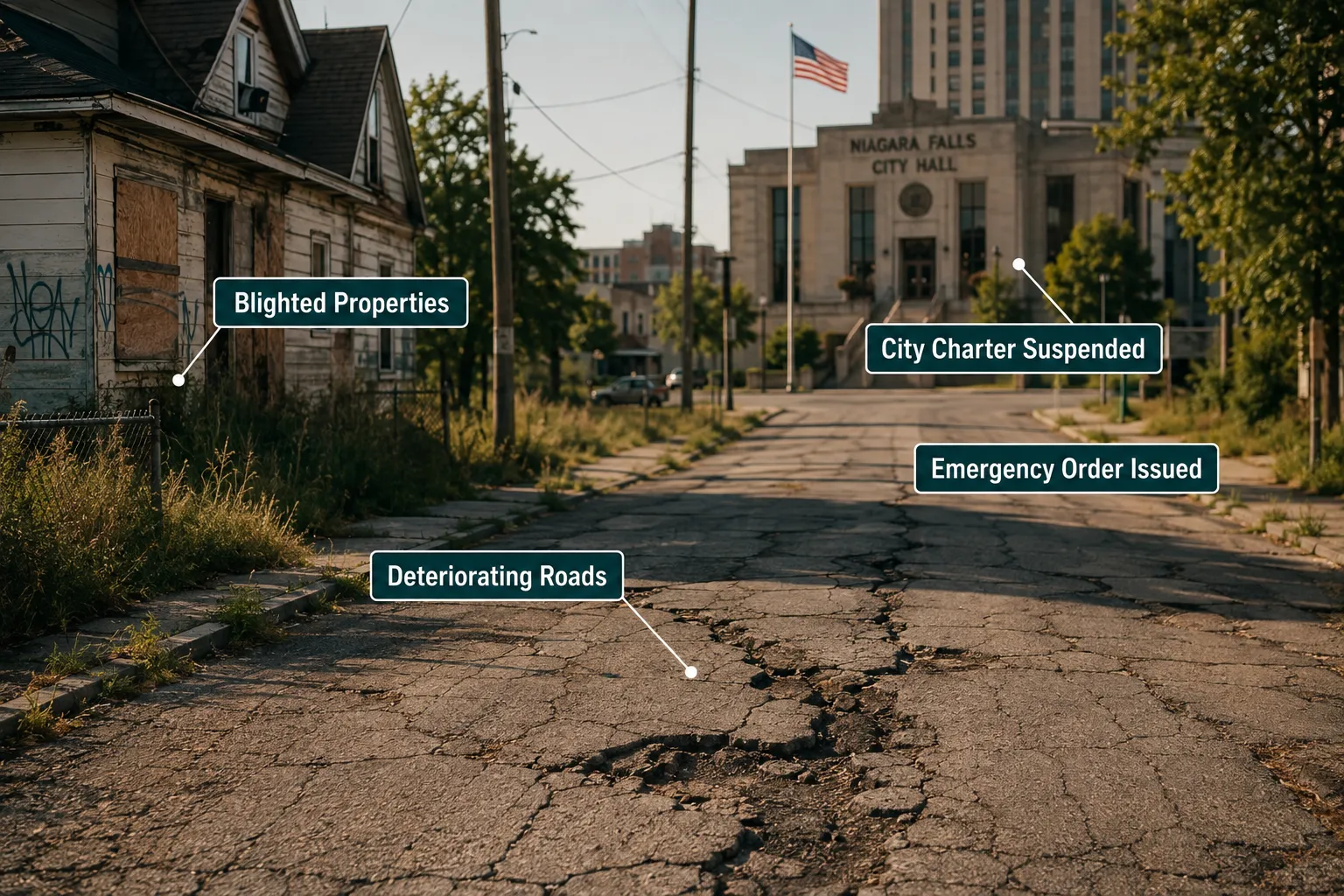
The declaration was not triggered by a natural disaster, a crime spike, or a tourism-related incident. Instead, it reflects a governance breakdown: the mayor argued that the City Council had failed, and in some cases outright refused, to approve contracts for routine maintenance work, leaving the city unable to address conditions that had become safety hazards. [2]
What specifically drove the emergency:
- Private landowners across the city had allowed grass, weeds, and brush to grow unchecked for weeks, creating fire risks and public health concerns.
- Multiple roadways had deteriorated to a point where resurfacing was considered urgent.
- The City Council had not approved the necessary maintenance contracts, blocking the administration from acting through normal channels.
- The fire chief highlighted the property conditions as a public safety risk, adding official weight to the mayor’s concerns. [1]
This is an important distinction for visitors: the emergency is about municipal governance and infrastructure maintenance, not an acute natural disaster or public safety crisis that would close the falls or surrounding attractions.
What Caused the State of Emergency in Niagara Falls and When Was It Declared?
The state of emergency was declared on July 20, 2026, and was still in effect as of August 16, 2026, nearly a month after its initial issuance. [1] The formal declaration was filed with both New York State and Niagara County, giving it legal standing beyond a purely local order.
The root cause was a combination of deferred municipal maintenance and a breakdown in the approval process between the mayor’s office and the City Council. Rather than waiting for council sign-off that was not forthcoming, Mayor Restaino used emergency powers to suspend three portions of the city charter related to council approval of contracts and certain budget expenditure restrictions. This allowed his administration to move forward with contracts for grass cutting, property cleanup, and road resurfacing immediately. [2]
Timeline of key events:
| Date | Event |
|---|---|
| July 20, 2026 | Mayor Restaino issues state of emergency declaration |
| July 20, 2026 | Declaration formally filed with New York State and Niagara County |
| August 15-16, 2026 | Local media reports the city remains under emergency; political dispute intensifies |
| August 17, 2026 | Mayor elaborates on the declaration and discusses possible extension [3] |
| August 3-4, 2026 | Separate flooding emergencies declared in Ontario’s Niagara Region [9] |
The 30-day structure means the initial emergency was set to expire around August 19, 2026, but the mayor confirmed it could be extended in 30-day increments if infrastructure work remained incomplete. [3]
What’s the Difference Between a State of Emergency and a Disaster Declaration?
A state of emergency and a disaster declaration are related but distinct tools, and understanding the difference matters for anyone trying to assess how seriously to take the Niagara Falls Mayor Declares State of Emergency, Tourism Impact in Focus situation.
A state of emergency is typically declared by a local or state executive (a mayor or governor) when conditions threaten public safety and require immediate action that bypasses normal administrative processes. It grants the declaring authority broad powers, including the ability to suspend certain laws, expedite contracts, and mobilize resources, without necessarily requiring legislative approval. In the Niagara Falls, New York case, this meant suspending city charter provisions to allow maintenance contracts to proceed without council sign-off. [2]
A disaster declaration, by contrast, is usually issued after a catastrophic event (a flood, hurricane, or earthquake) and is often used to unlock state or federal financial assistance. It typically follows an emergency declaration and involves a formal request to higher levels of government.
Key differences at a glance:
- Trigger: Emergency declarations can be precautionary or governance-driven; disaster declarations typically follow an actual catastrophic event.
- Scope of powers: Emergency declarations often suspend normal administrative rules; disaster declarations primarily unlock funding and resource transfers.
- Who declares: Emergencies can be declared by mayors or local executives; disaster declarations often require state or federal involvement.
- Tourism impact: An emergency declaration does not automatically close businesses or attractions; a disaster declaration following a major event is more likely to disrupt access.
In the Ontario context, the August 2026 flooding in municipalities like St. Catharines and Lincoln was closer to a disaster-response scenario, with local leaders using emergency declarations to seek higher-level government assistance and coordinate flood response. [9]
How Does the State of Emergency Affect Niagara Falls Tourism?
The state of emergency on the New York side has not shut down Niagara Falls attractions, and the region’s tourism season remains active. However, the Niagara Falls Mayor Declares State of Emergency, Tourism Impact in Focus story does carry real implications for visitor experience, particularly around road conditions and the visual quality of neighborhoods near tourist corridors.
Despite the emergency, tourism officials in mid-2026 described the Niagara region as having a “busy tourism season.” Even earlier disruptions, such as wildfire smoke from northwestern Ontario in July 2026 that forced temporary closure of some outdoor patios and paused nightly fireworks, were characterized by Niagara Falls Tourism’s interim president and executive director, Adam Stiles, as short-term adjustments rather than structural hits to demand. [13]
What the emergency does and does not affect for tourists:
- Road conditions: Some roads on the New York side may be in poor condition or under active resurfacing. Visitors driving in from the American side should expect possible detours or delays.
- Property appearance: Blighted and overgrown properties near tourist areas may affect the visual experience in some neighborhoods.
- Major attractions: The falls themselves, Niagara City Cruises, Journey Behind the Falls, and Skylon Tower on the Canadian side are not directly impacted by the New York emergency declaration.
- Events and fireworks: Separate from the emergency, wildfire smoke earlier in the summer caused temporary pauses to outdoor events, though these were expected to resume as conditions improved.
The broader context also matters: a shift in cross-border travel patterns in 2026, driven partly by political tensions between Canada and the United States, has pushed Niagara Falls destinations on both sides to focus more heavily on domestic and international visitors rather than cross-border traffic. [14] This means the region’s tourism ecosystem is adapting, but the core attractions remain fully operational.
For up-to-date information on what’s happening in the region, the Niagara Falls Tourism Updates August 2026 Event Calendar from BG Tours Canada is a useful reference.
Are Niagara Falls Attractions Closed Right Now?
As of August 2026, major Niagara Falls attractions on both the Canadian and American sides remain open. The state of emergency declared by Mayor Restaino in Niagara Falls, New York pertains to municipal infrastructure, not the closure of tourist sites or public attractions.
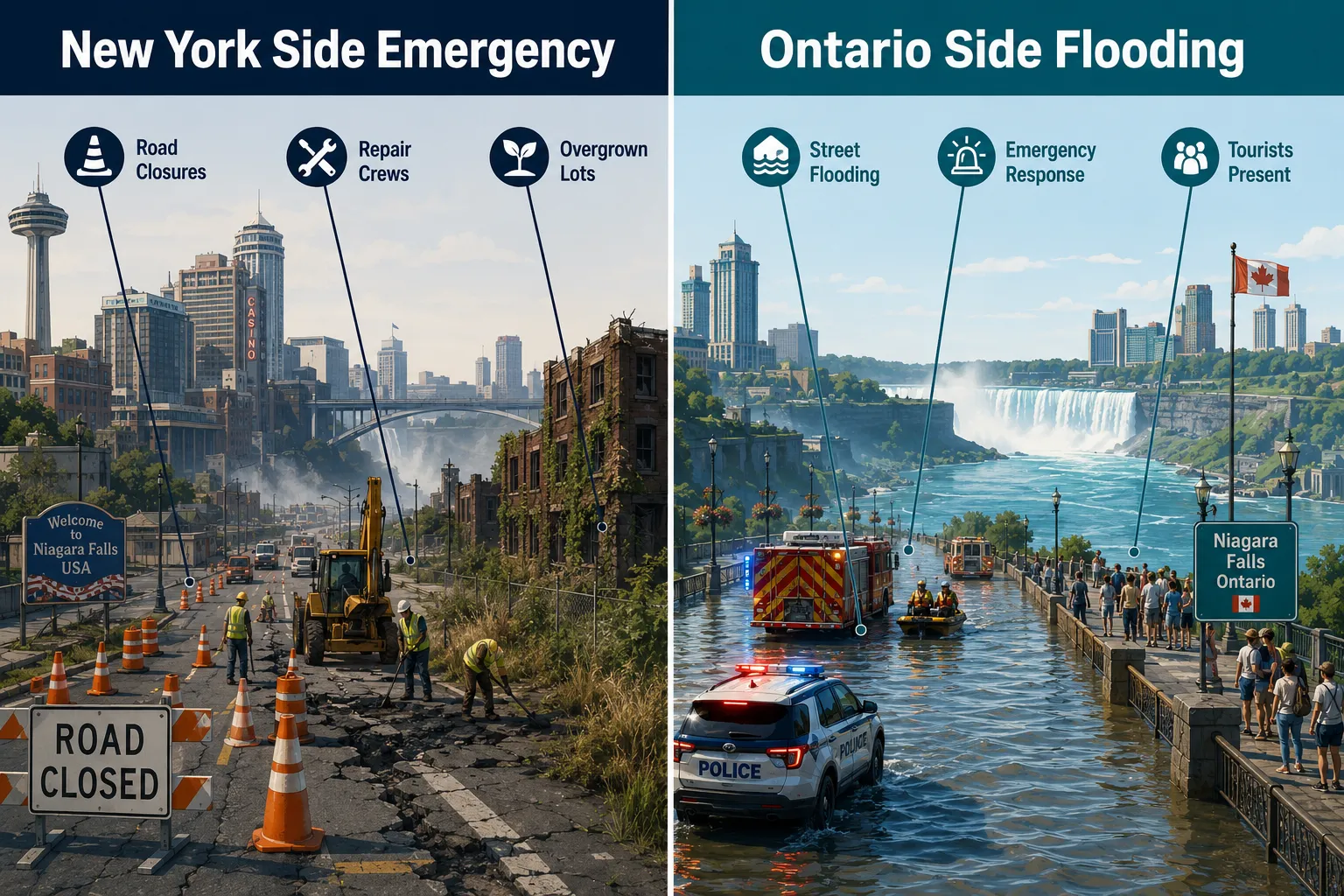
Current status of key attractions (as of August 2026):
- Horseshoe Falls (Canadian side): Open and accessible. No closures related to either the New York emergency or Ontario flooding have been reported at the falls themselves.
- Niagara City Cruises (Hornblower boat tour): Operating normally. The boat cruise is one of the most popular experiences and remains fully available.
- Journey Behind the Falls: Open. This attraction, which takes visitors 125 feet to an observation deck directly behind the falls, is not affected by the current emergency.
- Skylon Tower: Open. Panoramic views from the tower remain one of the region’s signature experiences.
- Niagara Parks Power Station: Open. This attraction now draws approximately 350,000 visitors annually and continues to operate. [8]
- Outdoor patios and fireworks: These were subject to temporary pauses earlier in summer 2026 due to wildfire smoke, but are expected to resume as air quality improves.
The Ontario flooding in early August 2026 caused localized damage in some Niagara Region municipalities, but the core tourist zone around Niagara Falls, Ontario was not reported as closed. [9]
Choose a guided tour if you want certainty: A structured tour with a knowledgeable operator like BG Tours Canada removes the guesswork. Guides have real-time awareness of conditions and can route around any disruptions, ensuring visitors access the best experiences without wasted time. Check things to do in Niagara Falls for current activity options.
Is It Safe to Visit Niagara Falls Now?
Yes, Niagara Falls is generally safe to visit in August 2026. The state of emergency in Niagara Falls, New York is an administrative and infrastructure measure, it does not indicate a public safety crisis of the kind that would make the area dangerous for tourists.
That said, a few practical precautions are worth noting:
- Road conditions on the New York side may be uneven or under repair. Pedestrians and drivers should exercise normal caution, particularly in areas away from the main tourist corridor.
- Air quality was a concern earlier in summer 2026 due to wildfire smoke from Ontario, which led to temporary outdoor patio closures and fireworks cancellations. Visitors with respiratory sensitivities should check current air quality indices before travel.
- Flooding impacts in parts of the Ontario Niagara Region (St. Catharines, Lincoln) in early August 2026 caused localized damage, but the main falls area was not reported as inaccessible. [9]
- Border crossing: Cross-border travel between Canada and the United States at Niagara remains operational, though wait times can vary. Check current wait times before crossing.
For families planning a visit, the Toronto to Niagara Falls with a stroller guide from BG Tours Canada covers practical logistics that remain relevant regardless of current conditions.
Bottom line: The falls are spectacular, the attractions are open, and the region is actively managing its infrastructure challenges. Visiting with a guided tour operator adds a layer of practical reassurance, as guides are briefed on current conditions and can adapt itineraries accordingly.
What Businesses Are Impacted by the Niagara Falls Emergency?
The businesses most directly affected by the Niagara Falls, New York state of emergency are those in or adjacent to neighborhoods with blighted properties and deteriorating roads. The emergency was specifically designed to address conditions that affect the city’s livability and, by extension, its attractiveness as a destination.
Business categories with potential exposure:
- Hotels and accommodation near affected road corridors: Guest access and curb appeal can be affected by road resurfacing work and overgrown neighboring properties.
- Restaurants and retail near blighted areas: Foot traffic may be lower in neighborhoods where property conditions have deteriorated.
- Tour operators and transportation companies: Road resurfacing work may require route adjustments, though major tourist thoroughfares are typically prioritized.
- Property maintenance and landscaping contractors: These businesses are likely to benefit directly, as the emergency declaration unlocks contracts for grass cutting and property cleanup. [2]
On the Canadian side, the August flooding in St. Catharines and Lincoln affected local businesses in those municipalities, with some property damage reported. The Niagara Falls, Ontario tourist core was not reported as broadly closed, but some businesses in flood-affected areas faced temporary disruption. [9]
What has not been significantly impacted:
- Major attractions (Skylon Tower, Journey Behind the Falls, boat cruises)
- The Niagara Parkway and main tourist corridors on the Canadian side
- Tour operators running guided experiences from Toronto
For visitors concerned about value and reliability, budget Niagara Falls bus tours remain a cost-effective and disruption-resistant option, since operators handle all logistics and routing.
How Long Will the Niagara Falls State of Emergency Last?
The initial emergency declaration issued on July 20, 2026 was set for 30 days, meaning it was due to expire around August 19, 2026. However, Mayor Restaino confirmed that the declaration could be extended in 30-day increments if the underlying infrastructure issues, blighted properties and deteriorating roads, had not been sufficiently addressed by that point. [3]
The mayor’s public comments after August 17 indicated that grass-cutting and cleanup work was actively underway, and that his administration would assess progress before deciding on any extension. [3] There is no fixed end date beyond the initial 30-day window, and the emergency remains in effect until rescinded by a new executive order.
Factors that will determine the duration:
- Speed of contractor mobilization for grass cutting, property cleanup, and road resurfacing
- Whether private property owners comply with municipal orders to address their own properties
- Resolution (or escalation) of the political dispute between the mayor’s office and City Council
- Whether the City Council eventually approves maintenance contracts through normal channels, reducing the need for emergency powers
For tourists, the practical implication is that road conditions and property appearance in some parts of Niagara Falls, New York may remain variable for weeks. Planning a visit to the Canadian side, or using a guided tour that handles all logistics, is the most reliable way to ensure a smooth experience regardless of how long the emergency lasts.
What Can Tourists Do During the Niagara Falls State of Emergency?
Tourists have a full range of options during the current state of emergency. The declaration does not restrict visitor access to the falls, the main attraction zones, or the Canadian side of the border. In fact, the majority of the most popular Niagara Falls experiences are unaffected.
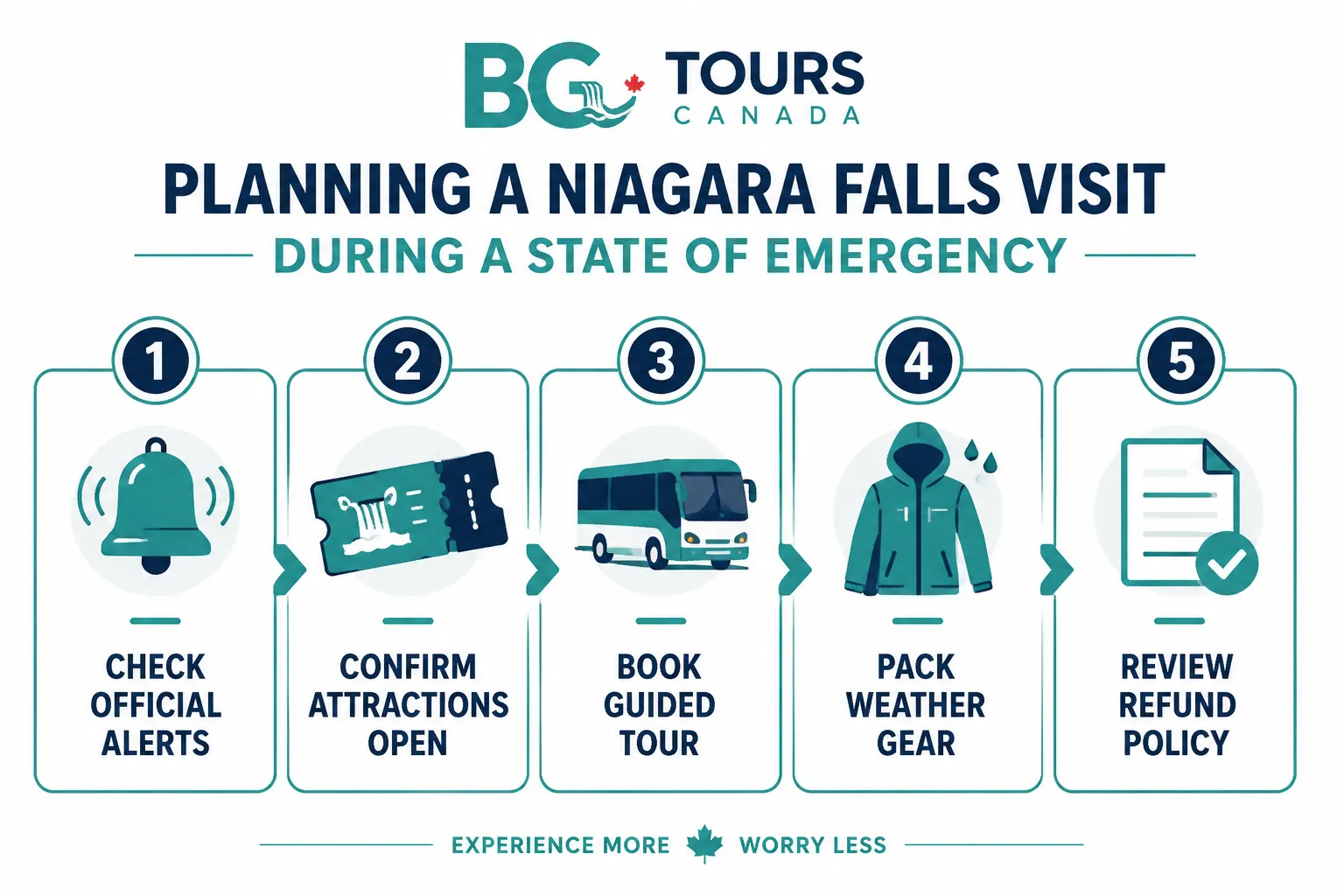
Practical options for visitors right now:
Book a guided tour from Toronto. A structured day tour removes all logistical uncertainty. BG Tours Canada’s Toronto to Niagara Falls Tour packages include comfortable coach transport, expert guides, and pre-arranged access to top attractions.
Experience the Hornblower Boat Cruise. Getting up close to the falls by water is one of the most memorable experiences available and is fully operational.
Visit Journey Behind the Falls. This 125-foot descent to an observation deck directly behind the cascading water is a signature experience that remains open.
Take in the views from Skylon Tower. Panoramic views of the falls and surrounding region from above are unaffected by the ground-level emergency.
Explore Niagara-on-the-Lake. A short drive from the falls, this charming town offers wine tours, historic sites, and a completely different atmosphere. Check out Niagara-on-the-Lake events for current programming.
Attend local festivals and events. The 2026 summer season has continued with events across the region. The Niagara Falls Salsa Festival and other summer programming remain on the calendar.
Check the Niagara Parks Power Station. This attraction, which draws 350,000 visitors annually, offers a fascinating look at the history of hydroelectric power alongside stunning tunnel and night show experiences. [8]
Choose a guided tour if: You want to maximize time, avoid navigating road disruptions independently, and benefit from expert local knowledge. BG Tours Canada’s guides are briefed on current conditions and can adapt routes and recommendations in real time.
How Often Does Niagara Falls Declare Emergencies?
Emergency declarations at Niagara Falls are not common, but the region has seen several in recent years for very different reasons, which helps put the current situation in perspective.
Recent emergency declarations in the Niagara region:
March-April 2024 (Ontario): Niagara Region declared a state of emergency ahead of the April 8 total solar eclipse, anticipating more than one million visitors in a single day. Mayor Jim Diodati described it as the largest single-day tourism spike in the city’s history. The emergency was precautionary, designed to protect health, safety, and infrastructure from potential overload. [7]
July 2026 (New York): Mayor Restaino’s declaration, driven by blighted properties and deteriorating roads, represents a governance-driven emergency rather than an event-driven one. [1]
August 2026 (Ontario): Flooding across parts of the Niagara Region led to emergency declarations in St. Catharines and Lincoln, with reports of flooding in the area. [9]
This pattern shows that emergency declarations in the Niagara region tend to be targeted and specific, addressing a particular challenge (crowd management, infrastructure, flooding) rather than signaling a broad breakdown in safety or services. The falls themselves have never been closed as a result of any of these declarations.
The 2024 solar eclipse example is particularly instructive: an emergency was declared not because something went wrong, but because officials wanted the tools to respond quickly if something did. Tourism continued at record levels. [7]
Will My Niagara Falls Trip Be Refunded?
Whether a trip to Niagara Falls qualifies for a refund depends on the specific booking terms of your tour operator, hotel, or attraction ticket, not on the state of emergency declaration itself.
Key points to understand:
- The current state of emergency in Niagara Falls, New York does not constitute a government-ordered closure of tourist attractions. This means most standard cancellation policies will apply as written.
- If an attraction you have booked closes temporarily due to flooding, smoke, or another specific disruption, the operator’s force majeure or weather policy would typically govern refund eligibility.
- Travel insurance that covers “travel disruption” or “government-ordered evacuation” may or may not apply to an infrastructure-related emergency declaration. Read your policy carefully, as coverage varies significantly between providers.
- Tour operators with flexible booking policies, including BG Tours Canada, are the safest choice when conditions are uncertain, as they can often reschedule rather than simply cancel.
Practical steps if you are concerned about your booking:
- Contact your tour operator or hotel directly and ask about their cancellation and rescheduling policy.
- Check whether your travel insurance covers disruptions related to emergency declarations.
- Monitor official communications from the City of Niagara Falls, New York and Niagara Falls Tourism (Ontario) for any attraction-specific closures.
- If you are booking a new trip, choose operators with clear flexible booking terms.
For visitors coming from Toronto, BG Tours Canada’s packages are structured to provide maximum value and flexibility. Explore current Niagara Falls packages to find options that suit your timeline and budget.
Frequently Asked Questions
Q: Is the state of emergency in Niagara Falls, New York still active in August 2026? Yes. As of August 16-17, 2026, the emergency declaration issued on July 20, 2026 remained in effect. It was set for an initial 30-day period with possible extensions in 30-day increments. [1][3]
Q: Did Mayor Jim Diodati of Niagara Falls, Ontario declare a state of emergency? Not directly related to the New York infrastructure emergency. However, Niagara Falls, Ontario’s broader region experienced significant flooding in early August 2026, and neighboring municipalities declared emergencies. Mayor Diodati’s own basement was reported as flooded during the August event. [9]
Q: Are the Niagara Falls boat cruises running normally? Yes. Niagara City Cruises (the Hornblower boat cruise on the Canadian side) is operating normally. The boat cruise is not affected by the New York state of emergency or the Ontario flooding reports.
Q: Can I still cross the border between Canada and the United States at Niagara Falls? Yes. Border crossings at Niagara Falls remain operational. Wait times vary by time of day and season, so checking current wait times before crossing is recommended.
Q: What caused the flooding emergency in Ontario’s Niagara Region in August 2026? Heavy rainfall on August 3-4, 2026 caused significant flooding across parts of the Niagara Region, leading to emergency declarations in municipalities including St. Catharines and Lincoln. [9]
Q: How does the 2026 emergency compare to the 2024 solar eclipse emergency? The 2024 eclipse emergency was precautionary, declared to manage an anticipated surge of over one million visitors in a single day. The 2026 New York emergency is governance-driven, addressing deferred infrastructure maintenance. Both are targeted measures, not signals of broad safety failures. [7]
Q: Will the state of emergency affect the Niagara Parks Power Station or Journey Behind the Falls? No. Both attractions are on the Canadian side and are not subject to the New York state of emergency. They remain open and operational.
Q: Is it better to visit the Canadian or American side of Niagara Falls right now? The Canadian side offers the most iconic views and is unaffected by the New York emergency declaration. Most guided tours, including those operated by BG Tours Canada, focus on the Canadian side for this reason.
Q: How long does a guided day tour from Toronto to Niagara Falls take? Most guided day tours from Toronto run approximately 9 hours, including travel time, guided commentary, and visits to key attractions. BG Tours Canada offers packages at this duration with options for boat cruises and tower visits.
Q: Where can I find the most current information about Niagara Falls attractions and events? The Niagara Falls Tourism Updates August 2026 Event Calendar from BG Tours Canada is a reliable source for current programming and attraction status.
Conclusion
The Niagara Falls Mayor Declares State of Emergency, Tourism Impact in Focus story is significant, but it is not a reason to cancel or postpone a visit to one of the world’s most extraordinary natural landmarks. The emergency in Niagara Falls, New York is fundamentally an infrastructure and governance issue, blighted properties, deteriorating roads, and a political dispute over contract approvals, rather than a public safety crisis that threatens the visitor experience at the falls themselves. [1][2]
Major attractions on both sides of the border remain open. The 2026 tourism season continues to be active, and the region’s long-term appeal is unchanged. The Niagara Parks Power Station draws 350,000 visitors annually, boat cruises run daily, and the falls continue to draw visitors from around the world. [8]
Actionable next steps for anyone planning a visit:
- Check current conditions before travel, particularly for road access on the New York side and air quality if wildfire smoke is a concern.
- Book a guided tour from a reputable operator. BG Tours Canada’s Toronto to Niagara Falls Tour packages handle all logistics, route around any disruptions, and ensure access to the best experiences with expert commentary.
- Review your booking terms and travel insurance if you have existing reservations, particularly for any outdoor events or New York-side activities.
- Consider the Canadian side as your primary base. The Canadian perspective offers the most dramatic views and is entirely separate from the New York emergency declaration.
- Stay informed through the Niagara Falls Tourism Updates August 2026 Event Calendar for real-time updates on events, attraction status, and any new developments.
Niagara Falls has weathered emergencies before, from record solar eclipse crowds in 2024 to flooding in 2026, and has continued to deliver extraordinary experiences for visitors each time. With the right preparation and a knowledgeable guide, a trip to the falls in 2026 remains as rewarding as ever.
References
[1] City Of Niagara Falls Under State Of Emergency – https://spectrumlocalnews.com/nys/buffalo/news/2026/08/16/city-of-niagara-falls-under-state-of-emergency
[2] Niagara Falls Mayor In Rebuke Of The City’s Council Declares State Of Emergency – https://www.btpm.org/local/2026-08-15/niagara-falls-mayor-in-rebuke-of-the-citys-council-declares-state-of-emergency
[3] Niagara Falls Mayor Elaborates On State Of Emergency Declaration – https://www.btpm.org/local/2026-08-17/niagara-falls-mayor-elaborates-on-state-of-emergency-declaration
[4] Mayor Declares State Emergency Falls – https://www.yahoo.com/news/us/articles/mayor-declares-state-emergency-falls-035900292.html
[5] Niagara Falls Councilmember Responds To Mayor’s State Of Emergency Declaration – https://www.btpm.org/local/2026-08-16/niagara-falls-councilmember-responds-to-mayors-state-of-emergency-declaration
[7] Solar Eclipse Niagara Falls – https://www.cbc.ca/news/canada/hamilton/solar-eclipse-niagara-falls-1.7159987
[8] Daily Update – https://gncc.ca/news/daily-update/
[9] Flood Hit Niagara Municipalities Declare Emergencies – https://www.theglobeandmail.com/canada/article-flood-hit-niagara-municipalities-declare-emergencies-call-for/



