

Last updated: May 29, 2026
Quick Answer: No, you cannot swim in Niagara Falls — and attempting it is both illegal and almost certainly fatal. The Niagara River features currents reaching up to 35 mph near the falls, water temperatures cold enough to cause hypothermia within minutes, and a sheer drop of up to 188 feet. Authorities on both the Canadian and American sides enforce strict no-swim zones, with fines and criminal charges for violations. [1][2]
Key Takeaways
- 🚫 Swimming near Niagara Falls is illegal on both the U.S. and Canadian sides, enforced by park rangers, coast guard units, and local police.
- 💨 Currents near the falls reach up to 35 mph — fast enough to overpower even elite swimmers in seconds. [2]
- 🌡️ Water temperatures stay dangerously cold year-round, raising the risk of cold water shock and hypothermia even in summer. [4]
- ⚠️ Penalties for unauthorized access include fines and potential criminal charges under U.S. federal regulations and Canadian provincial law. [1]
- 🌊 The Niagara Whirlpool downstream is equally deadly, with rotating currents that have claimed lives even in organized attempts. [5]
- ✅ Designated swimming areas exist far downstream — Queenston Beach near Niagara-on-the-Lake is the closest safe option, subject to daily water quality checks. [2]
- 🚢 The closest legal water access is via a licensed boat cruise, which brings passengers to the base of the falls at a controlled, safe distance.
- 🏆 A small number of people have survived going over the falls — but most attempts have ended in death or serious injury.
- 🎯 Safe, thrilling alternatives include the Hornblower/Niagara Cruises boat tour, Journey Behind the Falls, and panoramic views from Skylon Tower.
Is It Actually Legal to Swim Near Niagara Falls?
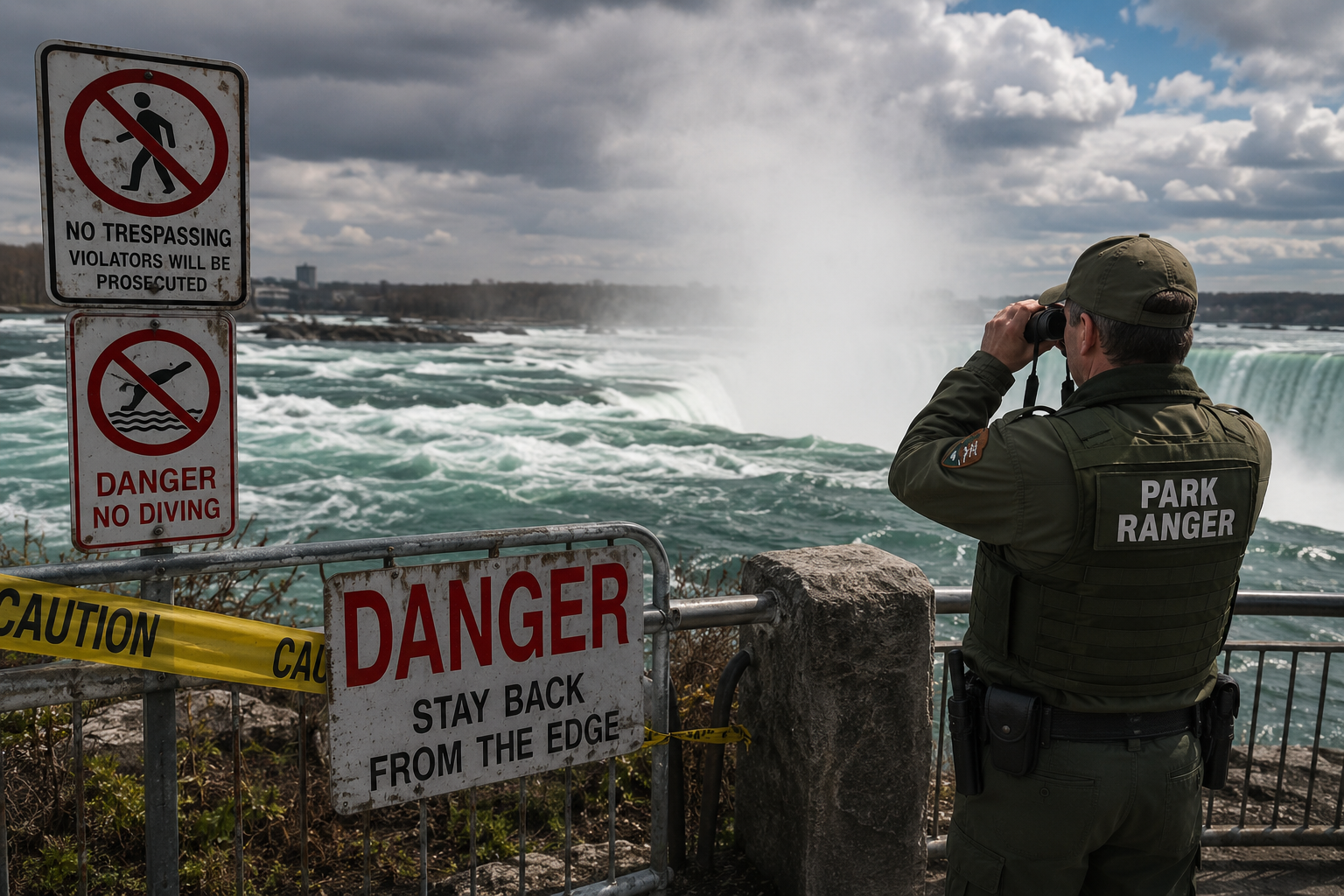
No — swimming in or near the Niagara River around the falls is explicitly illegal. On the U.S. side, the Code of Federal Regulations (33 CFR § 165.902) establishes permanent safety zones in the American waters of the Niagara River, prohibiting any unauthorized vessel or person from entering these restricted areas. [1] On the Canadian side, Niagara Parks Commission rules and Ontario provincial regulations enforce similar prohibitions.
This isn’t a grey area. The law applies to:
- The river above the falls (where deceptively calm water masks deadly currents)
- The gorge immediately below the falls
- The Whirlpool Rapids section downstream
- Any area within the marked safety buoys
Common mistake: Some visitors assume that because the water looks calm near the upper river banks, it’s safe to wade in. It isn’t. The current accelerates dramatically as it approaches the crestline, and the transition from “calm” to “uncontrollable” happens in a matter of feet.
How Dangerous Is Swimming Close to the Waterfall?
Swimming near Niagara Falls is almost certainly fatal. The combination of current speed, water temperature, hydraulic forces, and the sheer drop makes survival effectively impossible without intervention.
Here’s what the water actually does to a human body:
| Hazard | Detail |
|---|---|
| Current speed | Up to 35 mph near the brink [2] |
| Water temperature | Typically 40–50°F (4–10°C) year-round [4] |
| Drop height | Up to 188 feet (Horseshoe Falls) |
| Hydraulic force | Approximately 750,000 gallons per second flow rate |
| Hypothermia onset | Can begin within 3–5 minutes at these temperatures |
Even a strong swimmer standing waist-deep in the upper river near the falls would be unable to resist the pull of the current. The water accelerates to near-waterfall speed within a very short distance of the crestline, leaving no margin for recovery. [2]
Edge case: Some visitors have accidentally slipped into the river from rocks or railings. In almost every recorded case, the outcome without immediate rescue was fatal.
What Happens If Someone Accidentally Falls Into Niagara Falls?
The outcome depends almost entirely on where the person enters the water and how quickly rescue teams respond. Falls from the crestline or gorge walls are almost always fatal. Accidental entries further upstream — where current is slower — have occasionally allowed for rescue if responders act within seconds.
The sequence of events in a typical fall scenario:
- Entry into the current — the person is immediately pulled downstream
- Loss of control — within seconds, even strong swimmers cannot fight the current
- Approach to the brink — there is no natural eddy or safe zone to grab
- The drop — Horseshoe Falls drops 188 feet; the American Falls drop 70–110 feet
- Impact and submersion — the hydraulic pressure at the base can hold a body underwater for extended periods
Park authorities and rescue teams are positioned along the gorge and can deploy throw lines and boats, but response windows are extremely narrow. [1]
Are There Any Safe Zones Where You Can Get in the Water?
Yes — but they are far from the falls themselves. The only designated swimming area in the broader Niagara region is Queenston Beach, located in Niagara-on-the-Lake, several kilometers downstream from the falls. [2]
Key facts about Queenston Beach:
- Swimming is permitted only when daily water quality tests pass provincial standards
- The current here is significantly slower and the water is much shallower
- It is not part of Niagara Parks Commission territory — it falls under Niagara-on-the-Lake municipal oversight
- Lifeguard coverage varies by season and conditions
Choose Queenston Beach if: you want a legitimate swimming experience in the Niagara watershed. Avoid it if water quality flags are posted — the river can carry runoff after heavy rain.
For visitors who want to get close to the falls without risk, the best legal options are the licensed boat cruise (which takes passengers to the base of Horseshoe Falls) and the Journey Behind the Falls tunnel, which puts visitors 125 feet behind the curtain of water. Both are available through guided Niagara Falls tours that handle all logistics.
How Cold Is the Water Around Niagara Falls?
The Niagara River runs cold year-round, typically between 40°F and 50°F (4°C–10°C) even in peak summer. [4] This is because the water originates from the Great Lakes — primarily Lake Erie — which maintain low temperatures due to their depth and volume.
Why this matters for safety:
- Cold water shock can trigger involuntary gasping and hyperventilation within seconds of immersion, causing immediate loss of breath control
- Swimming failure — muscle function degrades rapidly in cold water, even in fit individuals
- Hypothermia — core body temperature begins dropping within 3–5 minutes at these temperatures
- Incapacitation — most people lose meaningful swimming ability within 10 minutes in 50°F water
In winter, the river surface near the banks can partially freeze, and ice formations build up around the falls — creating an additional physical hazard for anyone near the water’s edge.
What Penalties Exist for Trying to Swim in the Falls?
Penalties vary by jurisdiction but are serious on both sides of the border. On the U.S. side, violating the safety zone regulations under 33 CFR § 165.902 can result in civil fines and criminal penalties under U.S. Coast Guard authority. [1] On the Canadian side, Niagara Parks Commission bylaws and Ontario trespass legislation apply, with fines that can reach several hundred dollars for unauthorized access to restricted areas.
Beyond fines:
- Individuals who require rescue may be billed for emergency response costs in some jurisdictions
- Repeat or deliberate violations can result in criminal charges
- Stunt attempts (going over the falls intentionally) have historically resulted in criminal charges under Canadian law — one performer was fined and deported after a 1984 barrel stunt
The practical reality: park rangers, Niagara Parks Police, and the U.S. Coast Guard actively patrol these areas. Barriers, warning signs, and surveillance make unauthorized access difficult as well as illegal.
Has Anyone Ever Survived Going Over Niagara Falls?
Yes — a small number of people have survived, but the majority of attempts have ended in death. The first recorded survival was Annie Edson Taylor in 1901, who went over Horseshoe Falls in a wooden barrel and survived with minor injuries. Since then, an estimated 15–16 people have intentionally gone over the falls, with roughly half surviving. [3]
Notable survival cases:
- Annie Edson Taylor (1901) — barrel, survived
- Kirk Jones (2003) — no device, survived with injuries; later died in a second attempt in 2017
- A 7-year-old boy (2009) — accidentally fell in, survived with minor injuries due to the angle of entry
The key variables that affect survival:
- Entry angle and body position
- Whether the person was in a protective device
- Water levels at the time (affecting depth at the base)
- Speed of rescue response
The base of Horseshoe Falls contains a deep plunge pool that can absorb some of the impact — but the hydraulic recirculation zone (“the boil”) can hold a body underwater for minutes. Survival is the exception, not the rule. [3]
What Safety Measures Do Park Rangers Use to Prevent Swimming?
Both Niagara Parks Commission (Canada) and the U.S. National Park Service use a layered approach to prevent unauthorized water access. [1] These measures include physical barriers, active patrol, and public warning systems.
Specific measures in place:
- Fencing and railings along the gorge rim and riverbanks at all public access points
- Warning buoys placed in the river upstream to mark the point of no return
- Signage in multiple languages at all entry points and overlooks
- Niagara Parks Police patrol — dedicated officers on foot, vehicle, and boat
- U.S. Coast Guard patrol boats on the American side of the river
- Surveillance cameras monitoring key sections of the river and gorge
- Emergency throw lines and life rings stationed at intervals along accessible sections
Rangers are trained to respond to water emergencies and coordinate with Niagara Falls Fire Department rescue teams, who operate specialized swift-water rescue equipment.
Can Boats Get Close to Niagara Falls?
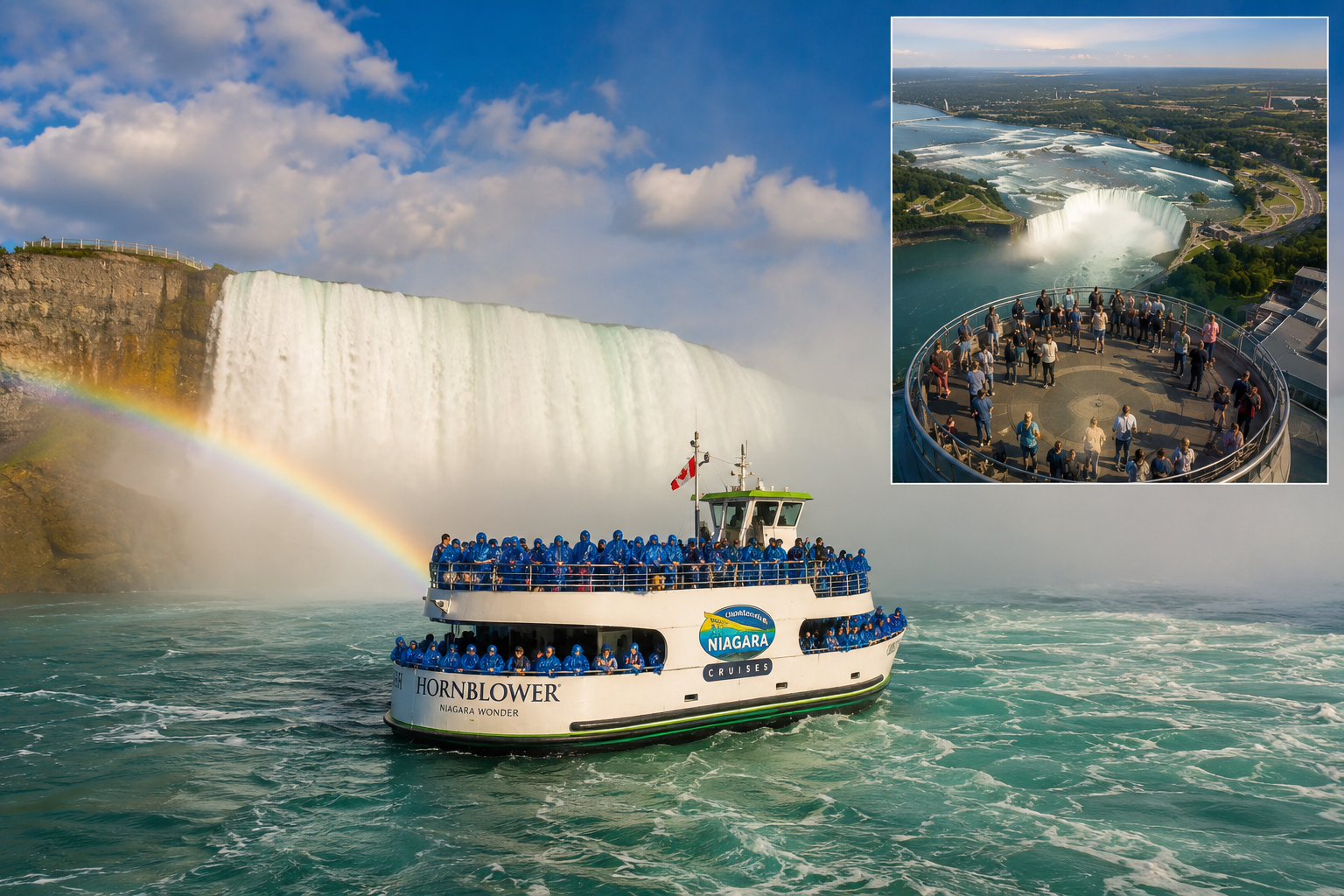
Yes — but only licensed commercial vessels operating under strict permit conditions. [1] The Hornblower Niagara Cruises (Canadian side) and the Maid of the Mist (American side) are authorized to navigate within a defined safe zone at the base of Horseshoe Falls.
These boats:
- Follow fixed routes approved by transport authorities
- Maintain a minimum safe distance from the base of the falls
- Operate with trained captains who understand the hydraulics of the basin
- Equip all passengers with waterproof ponchos (the mist is intense)
Private boats, kayaks, canoes, and personal watercraft are not permitted anywhere near the falls. The safety zone regulations prohibit unauthorized vessels from entering restricted areas of the Niagara River. [1]
For visitors wanting this experience, the boat cruise is one of the most popular inclusions in a Toronto to Niagara Falls tour with Boat Cruise, Journey Behind the Falls, and Skylon Tower. The guided format means all permits, timing, and logistics are handled — visitors simply show up and experience it.
Why Do People Try to Swim or Go Over Niagara Falls?
Motivations range from thrill-seeking and record attempts to mental health crises and, in some cases, publicity stunts. The falls have attracted daredevils since the 19th century, partly because the sheer scale of the challenge makes survival seem like an extraordinary achievement.
The main categories of attempts:
- Intentional stunts — barrel rides, tightrope walks, and swimming attempts for fame or prize money
- Accidental falls — slipping from rocks, railings, or boats; more common than intentional attempts
- Mental health emergencies — a significant proportion of incidents near the falls involve individuals in crisis; Niagara Parks has crisis intervention resources and trained staff on-site
The cultural mythology around the falls — the idea that surviving makes someone legendary — has driven attempts for over a century. The reality is that the odds are heavily against survival, and Canadian law now makes intentional stunts a criminal matter. [3]
What’s the Closest You Can Legally Get to the Water?
The closest legal water-level access is via the licensed boat cruise, which brings passengers within approximately 50–100 meters of the base of Horseshoe Falls. On foot, the closest legal vantage points are the observation decks at Table Rock (Canadian side) and Terrapin Point (American side), both of which put visitors at the crestline level with safety railings.
Legal proximity options, ranked by closeness:
- Boat cruise — water level, closest physical approach
- Journey Behind the Falls — 125 feet behind the waterfall, accessed via tunnel
- Table Rock observation area — crestline level, within meters of the brink
- Skylon Tower observation deck — aerial view from 775 feet above the falls base
For a complete breakdown of how to experience all of these in a single day, the Planning a 1-Day Niagara Falls Itinerary from Toronto guide covers timing, sequencing, and what to expect at each stop.
How Powerful Are the Currents Around Niagara Falls?
The Niagara River carries one of the highest flow rates of any river in North America, and the currents near the falls are among the fastest-moving freshwater in the world. [2] Upstream of the falls, the current accelerates from roughly 15 mph to over 35 mph as it approaches the crestline.
Current breakdown by section:
- Upper Niagara River (above falls): 15–25 mph, deceptively calm-looking surface
- Near the brink: 25–35 mph, visible acceleration and turbulence
- Plunge pool at base: extreme turbulence, hydraulic recirculation
- Whirlpool Rapids (downstream): Class VI rapids — the most dangerous whitewater classification [5]
- Niagara Whirlpool: rotating vortex with unpredictable current direction and depth
The Whirlpool, located about 1.5 km downstream from the falls, is a natural basin where the river makes a sharp turn. The rotating current can reach speeds that make escape impossible for any swimmer. [5] Visitors can safely view it from the Niagara Whirlpool and Aero Car — a cable car that crosses directly above the whirlpool at a safe height.
What Rescue Equipment Is Available Near the Falls?
Both the Canadian and American sides maintain dedicated swift-water rescue infrastructure, though the window for successful rescue near the falls is extremely narrow. Niagara Parks Police, Niagara Falls Fire Department, and the U.S. Coast Guard all have specialized equipment staged near the river.
Available rescue resources include:
- Throw lines and life rings at fixed stations along accessible riverbank sections
- Swift-water rescue boats capable of operating in the gorge below the falls
- Helicopter access for gorge rescues where boat access is impossible
- Trained swift-water rescue teams — Niagara Falls Fire Department maintains one of the most experienced swift-water units in Ontario
- Crisis intervention staff — Niagara Parks has trained personnel and posted crisis support information at key locations
The hard reality: even with all this equipment, rescue near the brink of the falls is nearly impossible once a person enters the main current. The response window is measured in seconds, not minutes. Equipment is most effective for gorge-level incidents below the falls, where the current, while still dangerous, allows more time for intervention.
Frequently Asked Questions
Q: Can you swim in Niagara Falls legally anywhere? No. Swimming is prohibited throughout the Niagara River near the falls and gorge. The only legal swimming in the broader area is at Queenston Beach in Niagara-on-the-Lake, far downstream, when daily water quality tests permit it. [2]
Q: Has anyone swum across the Niagara River? There are historical accounts of individuals attempting to swim portions of the upper Niagara River, but these are extremely rare, extremely dangerous, and not legally sanctioned. The Whirlpool Rapids section has claimed the lives of most who attempted it. [3]
Q: How cold is Niagara Falls water in summer? Even in July and August, the Niagara River typically runs between 40°F and 55°F (4°C–13°C). This is cold enough to cause cold water shock and swimming failure within minutes. [4]
Q: What happens if you accidentally fall into the Niagara River near the falls? Survival depends on exactly where you enter and how fast rescue responds. Near the brink, survival is virtually impossible. Further upstream, rescue teams may be able to reach a person if response is immediate. Most accidental falls near the crestline are fatal.
Q: Can you kayak or canoe near Niagara Falls? No. Private watercraft of any kind are prohibited in the restricted safety zones of the Niagara River near the falls. Only licensed commercial vessels with specific permits are authorized to operate in those areas. [1]
Q: Are there fines for trying to swim near the falls? Yes. Violations of U.S. federal safety zone regulations can result in civil fines and criminal penalties. Canadian violations under Niagara Parks bylaws and Ontario trespass law also carry fines. [1]
Q: What is the closest safe way to experience the falls at water level? The licensed boat cruise — Hornblower Niagara Cruises on the Canadian side — is the closest legal water-level experience, bringing passengers to the base of Horseshoe Falls under controlled conditions.
Q: Why is the Niagara Whirlpool so dangerous? The Whirlpool is a natural basin where the river makes a sharp bend, creating a rotating vortex. The currents are unpredictable, the depth is significant, and the rotating motion makes escape impossible for any swimmer. [5]
Q: Has a child ever survived going over Niagara Falls? Yes. In 2009, a 7-year-old boy accidentally went over Horseshoe Falls and survived with minor injuries. This is considered highly exceptional and is attributed to his small body mass, the angle of entry, and the water level at the time.
Q: What’s the best safe alternative to swimming near the falls? The boat cruise, Journey Behind the Falls tunnel, and Skylon Tower observation deck are the three best legal alternatives that provide close, immersive experiences without any risk. All three can be combined in a single day through a guided tour package.
Conclusion: Experience the Falls the Right Way
The answer to “Can You Swim in Niagara Falls? (And Other Crazy Questions)” is clear: no, and the reasons are compelling enough that no thrill is worth the risk. Currents reaching 35 mph, near-freezing water temperatures, a near-vertical drop of up to 188 feet, and strict legal prohibitions on both sides of the border make swimming in or near the falls one of the most dangerous things a person could attempt. [1][2]
The good news is that Niagara Falls doesn’t need to be conquered to be extraordinary. The licensed boat cruise puts visitors close enough to feel the mist and hear the roar. The Journey Behind the Falls tunnel places people 125 feet behind the water curtain. The Skylon Tower observation deck frames the entire scene from above. These experiences are not consolation prizes — they are genuinely spectacular, and they’re accessible to everyone.
Actionable next steps for your visit:
- Book a guided tour that includes the boat cruise and Journey Behind the Falls — the two closest legal approaches to the water. BG Tours Canada’s Toronto to Niagara Falls tour packages cover both, with expert guides who provide the geological and historical context that makes the falls even more impressive.
- Plan your itinerary around the full Canadian-side experience. The 1-day Niagara Falls itinerary guide is a practical starting point.
- Consider a private tour if you want flexibility and a more personal experience — the Niagara Falls Private Tour vs. Group Tour comparison breaks down which option suits different travel styles.
- Check the Queenston Beach water quality if you genuinely want to swim in the Niagara watershed — it’s the only legal and safe option.
The falls are one of the most powerful natural forces on the planet. Respecting that power is what makes the visit memorable — not defying it.
References
[1] Cfr Sect 33 165 902 – https://codes.findlaw.com/cfr/title-33-navigation-and-navigable-waters/cfr-sect-33-165-902/?utm_source=openai
[2] Can You Swim In Niagara Falls River – https://www.citizendailypost.com/faq/can-you-swim-in-niagara-falls-river?utm_source=openai
[3] Has Anyone Swam The Whirlpool Rapids At Niagara Falls – https://enviroliteracy.org/has-anyone-swam-the-whirlpool-rapids-at-niagara-falls/?utm_source=openai
[4] Can You Swim In Niagara Falls – https://newcanadianlife.com/can-you-swim-in-niagara-falls/?utm_source=openai
[5] Does Niagara Falls Have A Whirlpool – https://enviroliteracy.org/animals/does-niagara-falls-have-a-whirlpool/?utm_source=openai



